
Why Some PG Owners Stay Full While Others Struggle With Empty Beds
Two PGs on the same street. One is always full. The other has beds empty for weeks. The difference is rarely the building — it is operations.
Updated
Two PGs. Same city. Same rent.
One has a waiting list and beds booked within days. The other has five beds empty for three weeks — that is ₹40,000 gone this month alone at ₹8,000 per bed. Same market. Same city. The difference is almost never the building. It is how the PG is run.
Every PG owner wants the same thing: no empty beds.
Walk through any city in India and you will find two very different types of PGs operating side by side.
- The full PG — waiting list, quick bookings, tenants stay longer, revenue predictable
- The struggling PG — beds empty for weeks, frequent move-outs, rent stress because occupancy keeps dropping
The surprising part? The difference is rarely the building. It is rarely the furniture. And it is rarely location alone. More often than not, it comes down to operations.
The most expensive asset in your PG is an empty bed
Most owners obsess over expenses — electricity, staff salaries, Wi-Fi, maintenance, property rent. Very few calculate what an empty bed actually costs.
| Vacant beds | Rent per bed | Lost per month | Lost per year |
|---|---|---|---|
| 1 bed empty 30 days | ₹8,000 | ₹8,000 | ₹96,000 |
| 3 beds empty | ₹8,000 | ₹24,000 | ₹2,88,000 |
| 5 beds empty | ₹8,000 | ₹40,000 | ₹4,80,000 |
| 10 beds empty (100-bed PG) | ₹8,000 | ₹80,000 | ₹9,60,000 |
Not because demand does not exist
That ₹4,80,000 did not disappear because nobody wanted a bed in your area. It disappeared because vacancies were not managed — move-outs were not anticipated, availability was not communicated fast enough, and empty beds sat invisible while prospects called the PG down the street.
Occupancy problems start before a bed becomes empty
Many owners think occupancy drops when a tenant leaves. In reality, occupancy problems begin weeks earlier.
- A tenant becomes unhappy — complaint ignored or slow to resolve
- Maintenance takes too long — geyser, Wi-Fi, water issue drags on
- Communication breaks down — rent disputes, visitor hassles, notice missed
- The tenant starts exploring alternatives — quietly, without telling you
- They move out — and you only notice when the bed is suddenly empty
By the time the bed is vacant, the real problem already happened. You are now filling a bed you should never have lost.
Full PGs focus on tenant experience — not just marketing
Most owners think: better occupancy comes from more marketing. Good operators know: better occupancy often comes from fewer move-outs.
Every tenant who stays one extra month saves you:
- Marketing cost to find a replacement
- Vacancy gap between move-out and move-in
- Administrative work — KYC, bed assignment, rent setup
- Move-in coordination and gate onboarding
Your cheapest growth channel
Happy tenants refer friends. Many PGs fill beds through word-of-mouth — not listings. Retention is not a soft metric. It is a revenue strategy.
Empty beds are often an information problem
A prospect calls. They ask: “Do you have a bed available?”
The owner says: “Let me check.” The manager says: “I think so.” The warden says: “Maybe Room 302.” The prospect never calls back.
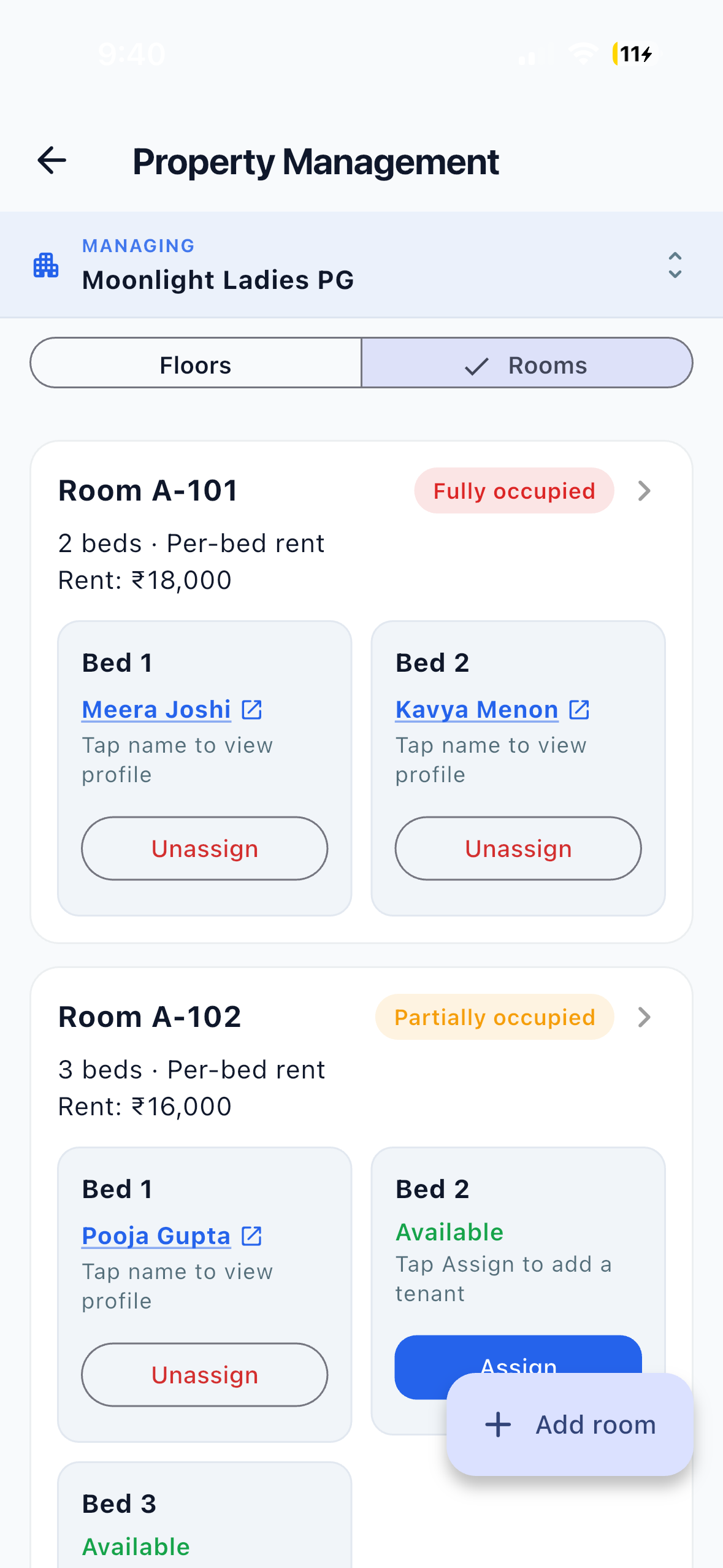
This happens every day — not because beds are unavailable, but because nobody knows availability with confidence.
The PG that wins the booking is the one that says: “Yes. One bed available in the boys wing. Move-in possible today.” — immediately, without three phone calls.
For the operational side of this, see how to track PG occupancy.
Full PGs know their numbers. Struggling PGs say “I’ll check.”
Ask a high-performing PG owner:
- What is your current occupancy?
- How many beds are vacant right now?
- Who is moving out in the next 30 days?
- What is your occupancy trend vs last month?
They answer immediately. Ask a struggling owner and the response starts with: “I’ll need to check.”
That delay has a price
Every day you do not know your vacancy count is a day a bed might sit empty while a prospect goes elsewhere. Businesses improve what they measure. If occupancy is not monitored actively, vacancies grow unnoticed — until rent collection becomes a crisis.
Why WhatsApp and Excel eventually break
At small scale, WhatsApp works. Excel works. Memory works. At 40, 60, 100 beds — they do not.
Information scatters across messages, calls, spreadsheets, notebooks, and staff phones. The owner spends more time finding information than acting on it. Every delay increases the chance a bed stays vacant longer.
If this sounds familiar: 5 signs your PG has outgrown WhatsApp.
The best PG owners think like hotel operators
Hotels obsess over occupancy. They do not wait until month-end. They monitor it constantly — daily, sometimes hourly.
Successful PG owners ask the same questions:
- Which beds are vacant today?
- Which tenants may leave next month?
- Which rooms have the highest turnover?
- Why are tenants moving out — pattern or one-off?
Answer these four questions with numbers instead of a guess, and you already know where the empty beds are coming from.
The hidden occupancy killer: slow operations
Many vacancies are not caused by pricing. They are caused by operational delays after a move-out.
- Tenant moves out — bed marked vacant (maybe)
- Room cleaning takes five days
- Maintenance takes another three days
- Photos and listing not updated
- Availability not communicated to staff at gate
- Bed sits empty for two weeks while everyone assumes “demand is slow”

Two weeks empty = ₹4,000 lost
At ₹8,000/month, every week a bed sits empty costs roughly ₹2,000. Two weeks of “operational delay” after move-out is ₹4,000 per bed — pure loss, before you spend a rupee on marketing to fill it again.
PGs that stay full usually do five things well
1. They track occupancy daily — not monthly
Vacant beds are a daily metric. Waiting until month-end to discover you were at 88% occupancy for three weeks means you already lost the revenue.
2. They resolve complaints quickly
Small issues become move-outs when ignored. A geyser complaint unanswered for five days is a tenant researching other PGs by day six.
3. They know upcoming vacancies
They do not wait for the tenant to leave. Move-out requests are tracked weeks ahead — marketing and walk-in responses start before the bed is empty.
4. They maintain accurate availability
Owner, manager, and warden all see the same bed-level status. No “let me check” when a prospect is on the phone.
5. They operate with systems — not memory
Information lives in processes, not in someone’s head. If the warden is on leave, occupancy data is still visible.
Occupancy is not always a marketing problem
When beds stay empty, the first instinct is: “I need more leads.” Sometimes that is true. Often the real issue is:
- Poor tenant retention — move-outs you could have prevented
- Slow operations — beds empty longer than necessary
- No visibility — you did not know you had five vacant beds
- Delayed responses — prospects lost before you confirmed availability
- Inefficient management — rent chasing eats time that should go to filling beds
Generating more leads without fixing operations is like pouring water into a leaking bucket. Fix the leaks first.
When rent chaos distracts you from filling beds, read the hidden cost of chasing rent — hours spent on screenshots are hours not spent on occupancy.
What growing PG owners are realising
The PG industry is becoming more competitive. Tenants have more options. Expectations are rising. Operations that worked five years ago are harder to sustain.
The owners who keep growing are not necessarily those with the biggest properties. They are the ones who understand their numbers, streamline operations, and create a better experience for tenants.
Final thoughts
Every empty bed has a cost — not just in lost rent, but in wasted marketing, missed walk-ins, and reduced profitability across the property.
The best PG owners do not wait for occupancy problems to become visible at month-end. They track vacancies early, understand why tenants leave, and build systems that reduce empty beds before revenue drops.
Because in the PG business, profitability is rarely determined by how many beds you have. It is determined by how many beds stay occupied.
EasyAavaas helps PG owners track bed-level occupancy, monitor upcoming vacancies, manage tenant requests, and run daily operations from one platform — giving you the visibility to keep properties running at full potential.
For the full operational playbook, see The complete guide to running a PG, hostel or co-living space in India.
Measure availability before promising a room
Record the snapshot date, available beds, active assignments and planned move-outs. Use the occupancy calculator to check the denominator. Good operating records support enquiry follow-up; local demand, property quality, pricing and service still influence whether an enquiry becomes a resident.