

5 Signs Your PG Has Outgrown WhatsApp
Rent reminders, complaints, visitor approvals, move-outs — all on WhatsApp? Here are five signs your PG has outgrown chat-based operations.
Updated
Does this sound like your morning?
You open WhatsApp before breakfast. Seventeen unread messages in the PG group. Three tenants sent rent screenshots overnight. Someone reported a geyser issue at 11 PM. The warden is asking if a visitor is allowed. You have not even reached the property yet — and the day has already started.
For many PG owners in India, WhatsApp is not just a messaging app. It has become the operating system of the business.
- Rent reminders go out on WhatsApp
- Tenant complaints arrive on WhatsApp
- Visitor approvals happen on WhatsApp
- Move-out requests come through WhatsApp
- Staff coordination runs in WhatsApp groups
At first, it feels convenient — everyone already uses it, there is no training, and messages feel instant. But as occupancy grows, WhatsApp quietly becomes one of the biggest reasons daily operations feel impossible to manage.
The problem is not WhatsApp itself. The problem is that WhatsApp was built for conversations — not for running a PG.
If you manage dozens of tenants, multiple rooms, staff members, and daily operations through chat groups, here are five signs your PG has outgrown WhatsApp.
1. You spend too much time chasing rent payments
Every month starts the same way. You send reminders. Some tenants pay immediately. Others send UPI screenshots. Some reply “Paid yesterday.” Others say “Will pay tonight.” A few forget completely.
Now you are scrolling through hundreds of messages trying to answer five simple questions:
- Who paid?
- Who did not?
- Which screenshot belongs to which tenant?
- Was the amount correct?
- Has anyone verified it yet?
By the tenth of the month, rent collection has become a full-time activity — on top of everything else you already do.

The hidden cost
It is not just the hours spent following up. Missed payments slip through. Duplicate records appear in your spreadsheet. Tenants dispute payment dates because there is no single source of truth. Outstanding rent becomes a guessing game — until month-end, when the accountant asks for numbers you cannot produce quickly.
A structured rent workflow — where tenants see what they owe, submit proof once, and staff verify in a defined process — replaces message archaeology with a clear payment trail.
2. Complaints keep getting lost
Picture a typical Tuesday evening in your PG group.
A tenant reports: “The geyser is not working.” You reply: “Will check.” An hour later, someone else says: “Wi-Fi is slow.” Then: “Water leakage in Room 203.” By bedtime, dozens of new messages have arrived — good-night forwards, rent reminders, and three separate maintenance issues mixed together.
Two days later, the geyser tenant follows up: “Any update?” You scroll back. The original message is buried under 200 newer ones. You did not ignore the complaint on purpose. It disappeared.
What tenants experience
No status updates. No timeline. No assignee. They follow up again — and again — which adds more messages to the same group. Frustration builds even when you genuinely intend to fix the problem.
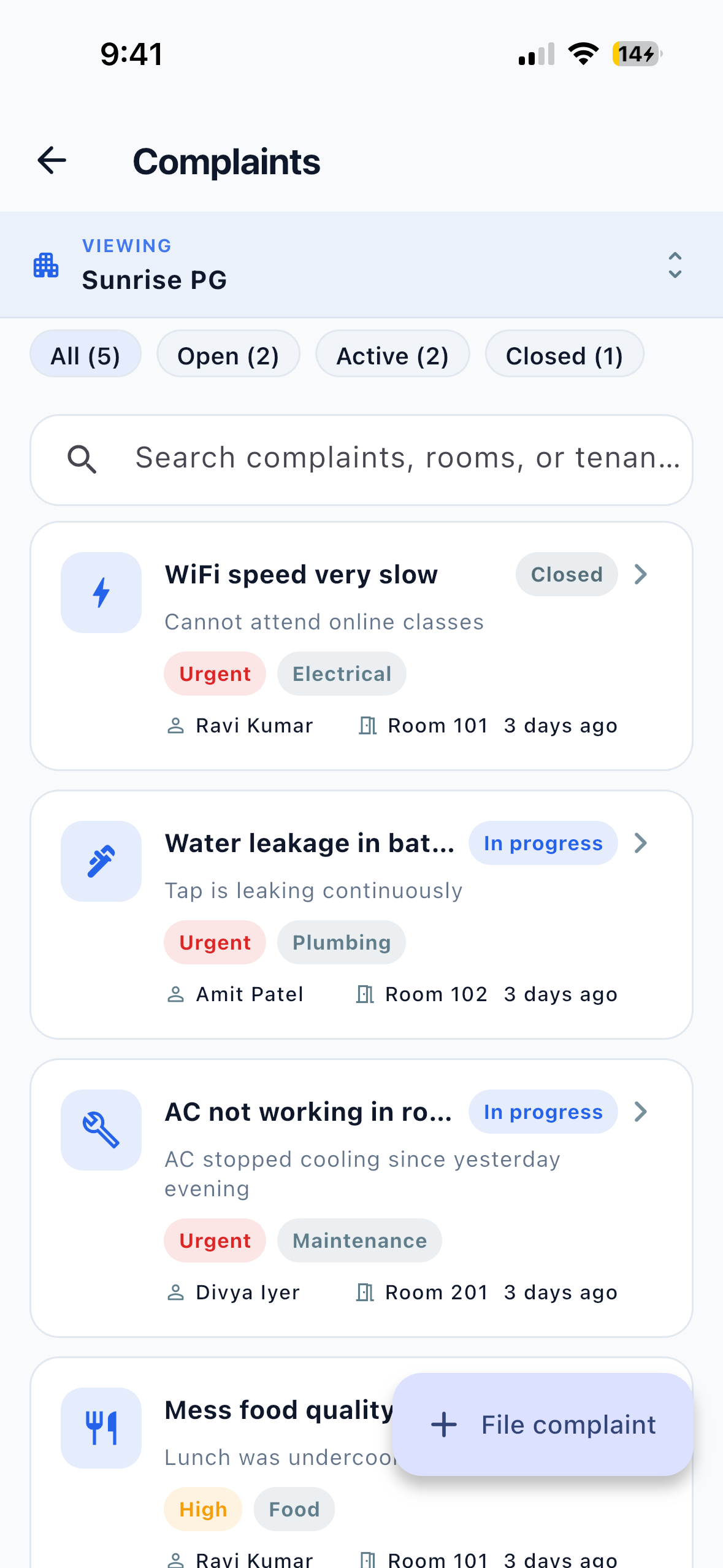
A dedicated complaint workflow keeps every request visible — with photos, priority, status, and resolution history — until it is actually closed.
3. Nobody knows which beds are actually vacant
A walk-in prospect arrives at the gate. They ask: “Do you have a bed available?”
You call the manager. The manager calls the warden. The warden checks a notebook — or a WhatsApp message from last week. Five minutes later, you are still not sure. Maybe Room 204 has one bed. Maybe someone is moving out Friday. Maybe you already promised that bed to someone who messaged yesterday.
Sound familiar?
Many PGs feel they know occupancy levels — until someone asks about a specific bed, room, or upcoming move-out. Then the answer is scattered across spreadsheets, messages, and verbal updates from staff.
Why this costs you money
Every vacant bed is lost revenue. Without live occupancy visibility, vacancies stay open longer, bookings get delayed, double allocations happen, and walk-in prospects leave before you confirm availability.
Growing PGs need bed-level occupancy — vacant, partial, and fully occupied — updated in one place, not reconstructed from three phone calls.
4. Your staff is constantly calling you
One of the clearest signs a PG has outgrown WhatsApp: every operational decision still routes through the owner.
Questions arrive all day long:
- Should this visitor be allowed?
- Has this payment been verified?
- Can we close this complaint?
- Is Room 105 available?
- Can this tenant move next week?
Instead of focusing on filling beds, improving the property, or opening a second PG, you spend the day answering the same types of questions — because the information exists only inside WhatsApp threads on your phone.
The real issue
This is usually not a staff performance problem. It is a systems problem. When rent status, visitor rules, and complaint history live in conversations, employees cannot work independently — even when they want to.
Role-based workflows let managers, wardens, and accountants access exactly what their job requires — without forwarding screenshots to the owner for every decision.
5. Month-end reporting feels like a nightmare
On the last day of the month, the accountant — or you — suddenly needs answers:
- How many beds are occupied?
- What is the total rent collected?
- How much is still pending?
- Which tenants moved out this month?
- What utilities were charged?
The data is somewhere across WhatsApp chats, Excel tabs, paper registers, and individual staff phones. You spend hours collecting information that should already exist in one report.
Why this becomes dangerous
Without accurate reporting, decisions become reactive. Revenue leaks go unnoticed. Occupancy trends are invisible. Planning the next property — or even next month — is based on guesswork instead of numbers.
A growing PG needs operational visibility, not a month-end scavenger hunt through chat history.
Why WhatsApp works — until it does not
WhatsApp is an excellent communication tool. It is not a property management platform.
Sending a message is fine. Running rent collection, occupancy, complaints, visitor approvals, staff permissions, and reporting through endless threads is not.
Conversations disappear. Processes should not.
As occupancy grows, PG owners need systems that handle daily operations without depending on message history — while still allowing WhatsApp for the casual communication it does well.
What growing PG owners do differently
Successful operators eventually shift from communication-based management to process-based management.
Instead of asking “Can I find this message?”, they ask “Can I find this information instantly?”
- Rent has a status — pending, submitted, verified, paid
- Complaints have an owner, a timeline, and a resolution
- Occupancy is live at bed level, not reconstructed from calls
- Staff act within permissions instead of waiting for the owner
- Reports export in minutes, not rebuilt from scratch
That shift changes everything. Operations get easier. Staff become more productive. Tenants get faster responses. Owners finally see what is actually happening across the property.
If spreadsheets are also part of the chaos, read our guide on PG management app vs Excel — many owners hit both walls at the same time.
Quick checklist — count how many apply
- Rent follow-ups consume hours every month
- Complaints get buried and tenants follow up repeatedly
- You cannot confirm bed availability in under a minute
- Staff call you for decisions that should not need you
- Month-end reporting takes half a day or more
If three or more apply, your PG is almost certainly operating beyond what WhatsApp and manual tools can support — and the inefficiency gets more expensive with every new tenant.
Final thoughts
If your day starts and ends with WhatsApp groups, you are not alone — most Indian PG owners begin exactly this way.
The goal is not to stop using WhatsApp. Tenants and staff will always use it for quick messages. The goal is to stop using WhatsApp as your management system.
Rent, rooms, complaints, visitors, and reporting deserve structured workflows — the same way a growing business deserves more than a single chat thread holding everything together.
That is what EasyAavaas is built for: moving PG owners from scattered conversations to structured operations — without forcing everyone to change how they communicate overnight.
For the full operational playbook, see The complete guide to running a PG, hostel or co-living space in India.
Keep support chat and operating records distinct
A WhatsApp group can coordinate people, while a rent record or complaint needs an owner and status. The EasyAavaas assistant requires property setup and enabled account access. It works within permissions; app notifications are a separate function. Read the assistant access details and use the manual reminder templates if you only need wording.