

The Complete Guide to Running a PG, Hostel or Co-Living Space in India
Finding tenants is the easy part. Running a PG, hostel, or co-living space consistently — occupancy, rent, complaints, visitors, staff — is where operators win or struggle. This is the full playbook.
Updated
Who this guide is for
Whether you run a 20-bed boys PG in Pune, a 120-bed student hostel in Bengaluru, or a multi-property co-living brand — this guide covers the operational systems that separate profitable operators from those stuck in daily firefighting. Bookmark it. Share it with your warden.
Running a PG, hostel, or co-living space looks simple from the outside. Find a property. Fill the beds. Collect rent. Repeat.
But every accommodation operator in India eventually learns the truth: the real challenge is not finding tenants. It is managing operations consistently as the property grows.
As occupancy increases, small issues become expensive problems — a missed rent payment, an unresolved complaint, an untracked move-out, a vacant bed sitting invisible, a lost key, a visitor dispute at the gate.
Individually, these seem manageable. Together, they determine whether your business grows profitably or becomes a daily struggle.
This guide covers the systems, processes, and operational practices used by successful PG, hostel, and co-living operators across India — with links to deeper articles on each topic throughout.
The modern accommodation business has changed
Five years ago, many PGs and hostels operated on registers, notebooks, Excel sheets, and WhatsApp groups. For a 15-bed property with one owner doing everything, that was often enough.
Today’s residents — students, working professionals, and co-living tenants — expect faster responses, digital communication, transparent billing, better security, and organised management.
- Operators who adapt gain a competitive advantage — higher retention, faster fill rates, fewer disputes
- Operators who do not struggle with vacancies, negative word-of-mouth, and operational inefficiencies that compound every month
The shift is not about luxury amenities. It is about operational reliability — the resident knows their rent status, the warden knows who is visiting, and the owner knows how many beds are empty today.
Ten steps every operator should get right
Step 1: Occupancy is everything
Every accommodation business runs on occupancy. You can have great interiors, a prime location, and excellent amenities — but if beds remain empty, profitability suffers.
The first metric every operator should track:
Occupancy rate = Occupied beds ÷ Total beds × 100
Example: 100 beds, 92 occupied → 92% occupancy. Track this weekly, not at month-end.
| Occupancy | 100 beds at ₹8,000/bed | Monthly revenue |
|---|---|---|
| 100% | 100 occupied | ₹8,00,000 |
| 95% | 95 occupied | ₹7,60,000 |
| 90% | 90 occupied | ₹7,20,000 |
| 85% | 85 occupied | ₹6,80,000 |
Five empty beds = ₹40,000/month gone
At ₹8,000 per bed, five vacant beds cost ₹40,000 every month — ₹4,80,000 per year — before you spend a rupee on marketing to fill them again. Occupancy is not a reporting metric. It is a daily operational priority.
Go deeper: How to track PG occupancy · Why some operators stay full
Step 2: Build a proper tenant lifecycle
Most operators focus heavily on move-ins. Successful operators manage the entire tenant journey — from first enquiry to final key return.
Move-in
- Identity proof and document collection
- Emergency contact with 24×7 flags where needed
- Security deposit and advance rent records
- Room and bed allocation — not just “Room 204” but Bed B in Room 204
- Join code or onboarding workflow for app-based properties
- Custody items logged — keys, remotes, access cards
Active stay
- Rent status — due, submitted, verified, paid
- Utility charges bundled or itemised with meter readings
- Complaints filed, assigned, and resolved with history
- Visitor pre-approvals and gate check-in/out
- Notices and property-wide announcements
- Room change or transfer requests when needed
Move-out
- Notice period recorded and move-out date tracked
- Final rent settlement and utility reconciliation
- Deposit adjustments documented
- Custody items returned before vacate is approved
- Room inspection and bed marked vacant for re-marketing
A structured lifecycle reduces disputes, speeds up bed turnover, and creates consistency whether you operate one PG or ten properties.
Step 3: Fix rent collection before it becomes a problem
Rent management is one of the most common operational challenges in PGs, hostels, and co-living spaces. Many properties still rely on WhatsApp screenshots, manual Excel tracking, and follow-up calls every month.
The larger the property, the harder this gets. Effective rent management requires visibility into:
- Due amounts per tenant — auto-generated monthly where possible
- Payment status — pending, submitted, verified, paid
- Verification workflow — who approved, when, with proof attached
- Outstanding balances — property-wide and per tenant
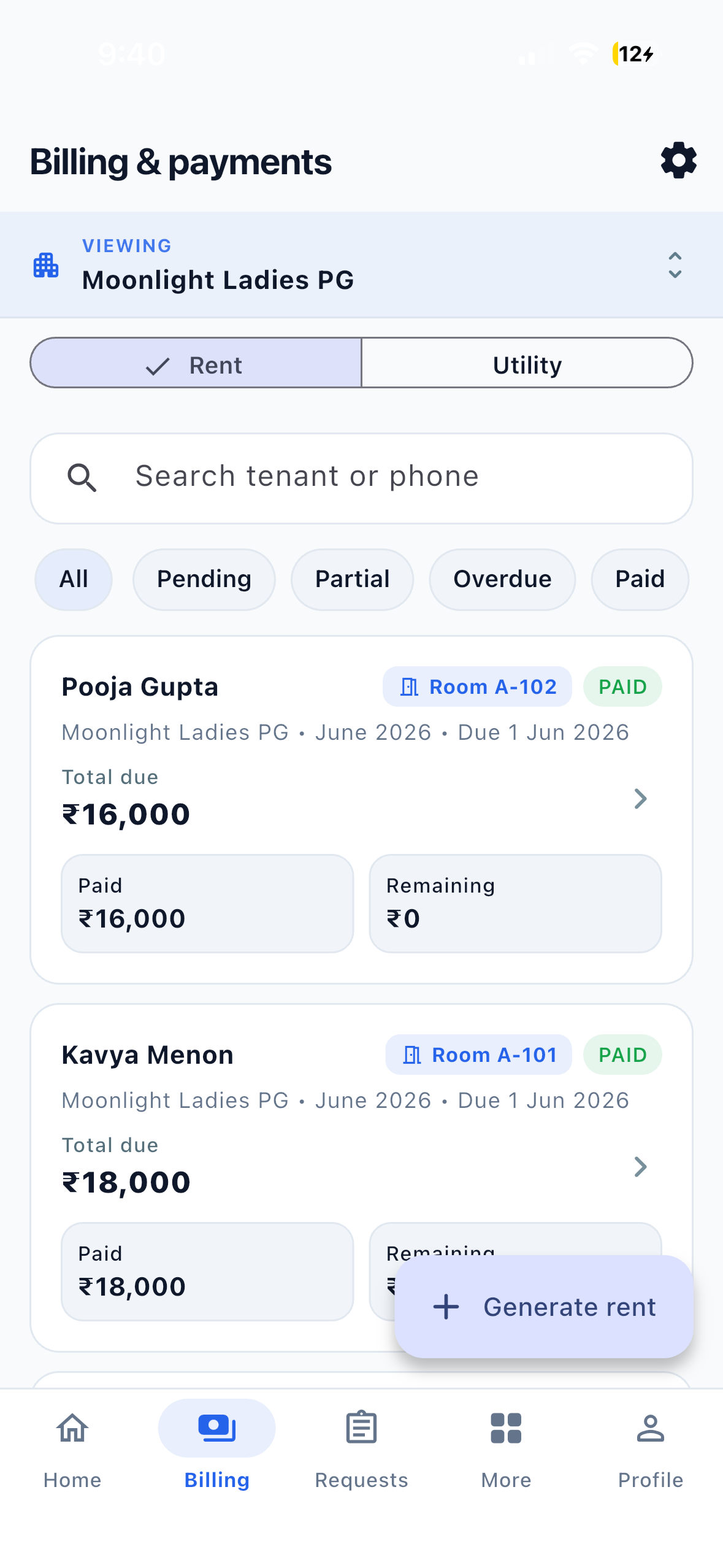
Rent collection should operate as a process, not a crisis on the 1st of every month. Tenants see what they owe, submit UPI proof once, staff verify in a defined workflow — no scrolling through hundreds of messages.
Go deeper: The hidden cost of chasing rent · 5 signs you have outgrown WhatsApp
Step 4: Track beds, not just rooms
This is where many operators lose visibility — and revenue.
Consider Room 101 with four beds: three occupied, one vacant. If you track only rooms, Room 101 shows “occupied.” The available bed is invisible. A walk-in prospect asks for a bed; you say no vacancy — and lose ₹8,000 per month until someone manually notices the gap.
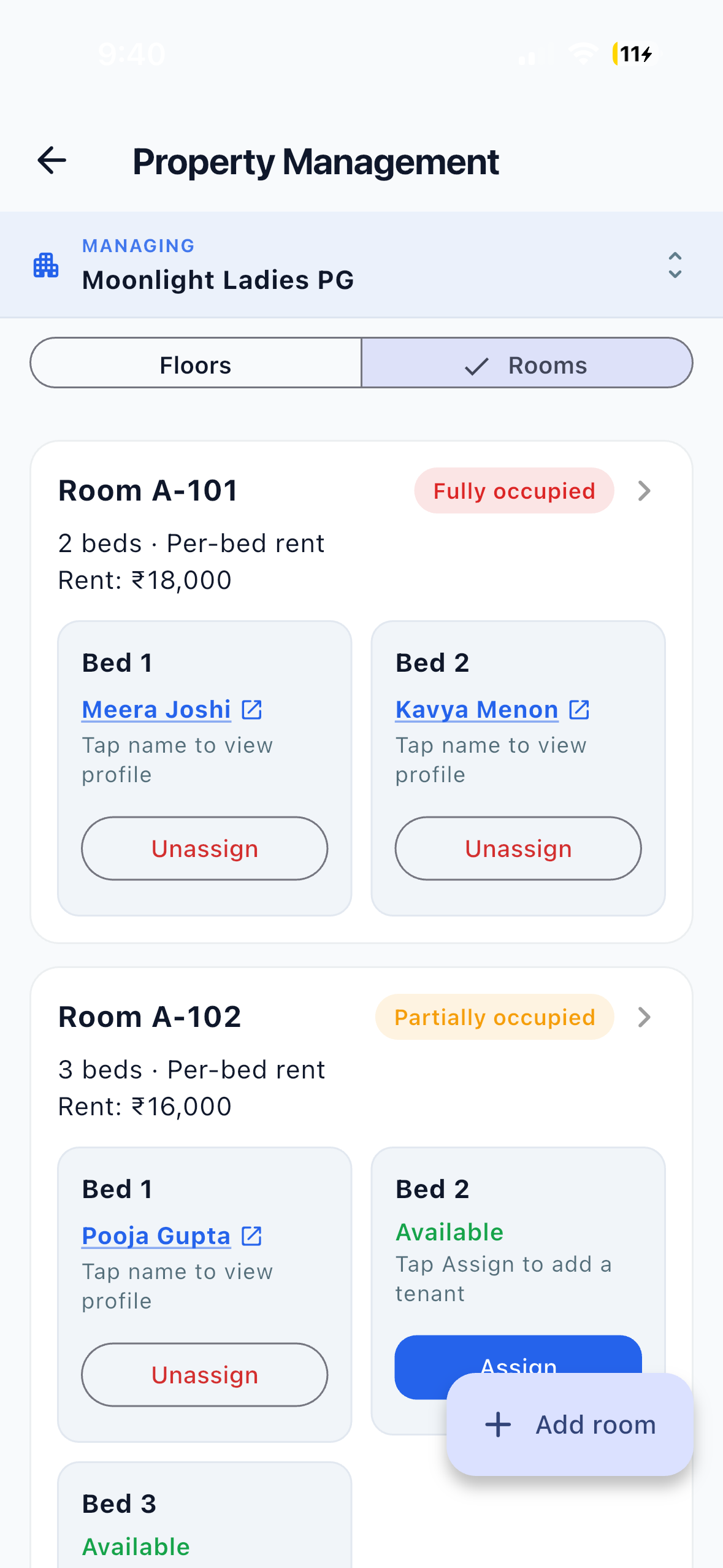
Shared accommodations should always operate at floor → room → bed level. This improves occupancy visibility, revenue forecasting, availability answers for prospects, and per-bed or per-room billing flexibility.
Step 5: Complaints are more important than you think
Many operators view complaints as interruptions. In reality, complaints provide operational insight and retention signals.
- Wi-Fi and connectivity issues
- Water supply and geyser problems
- Maintenance and repair requests
- Cleaning and housekeeping concerns
- Room change or roommate conflicts
Unresolved complaints create frustrated residents, negative reviews, and increased move-outs — each move-out triggering vacancy cost, marketing, and admin work.
The goal is not zero complaints
The goal is to ensure every complaint is acknowledged, assigned, tracked with photos where needed, and resolved with a visible status thread. Prompt, visible follow-up can improve the resident experience. Retention also depends on the property, service, price and individual circumstances.
Step 6: Visitor management impacts safety and trust
One unexpected visitor at the gate creates immediate confusion — in PGs, girls hostels, and co-living spaces where security expectations are high.
- Was approval granted?
- Who approved it — owner, warden, or tenant?
- When did they enter and have they left?
- Is this a registered guest or someone unknown?
As occupancy increases, visitor management becomes essential. A structured pre-approval and check-in/out process protects residents, staff, and property owners while reducing gate disputes.
Step 7: Create clear staff responsibilities
Growing properties add wardens, managers, accountants, and support staff. Without clear responsibilities and scoped access, confusion follows.
- Who handles complaints — warden or manager?
- Who verifies rent payments — accountant or owner?
- Who approves visitors — warden at gate or tenant in app?
- Who updates occupancy when someone moves out?
The best operations define responsibilities clearly and ensure each role has access only to what their job requires — not the entire tenant database, not every financial record, not every property if they manage one site.
When every decision routes through the owner, growth hits a ceiling. Role-based permissions let staff work independently within defined boundaries.
Step 8: Use data to make decisions
Many operators rely on assumptions. Successful operators rely on data they can pull in minutes.
Every week, you should know:
- Current occupancy — overall and per property
- Vacant beds available today
- Upcoming move-outs in the next 30 days
- Outstanding rent — total and by tenant
- Open complaints and average resolution time
- Property-wise performance comparison
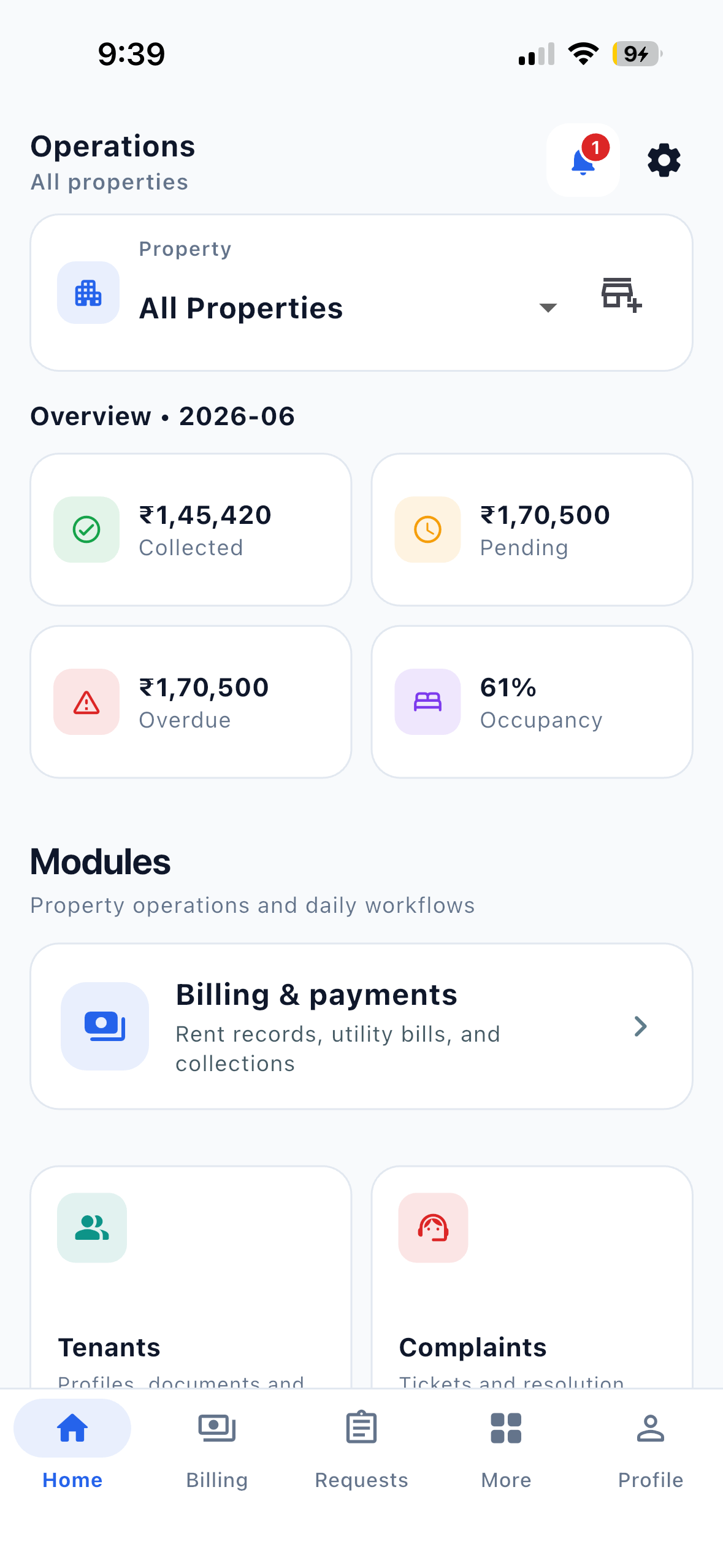
When this information lives in Excel tabs, WhatsApp threads, and notebooks, decisions wait — and opportunities pass. Centralised reporting lets owners act on facts, not memory.
Go deeper: PG management app vs Excel · 7 ways owners lose money
Step 9: Focus on retention, not just acquisition
Many operators invest heavily in attracting new residents — listings, brokers, walk-in marketing. Few invest equally in keeping existing residents happy.
Retention has a direct impact on profitability. Longer stays mean:
- Lower vacancy risk and fewer empty-bed weeks
- Reduced marketing spend per occupied bed
- Less move-in admin — KYC, bed setup, rent onboarding
- Higher lifetime value per resident
- Word-of-mouth referrals from satisfied tenants
Retention beats acquisition
Keeping one tenant one extra month at ₹8,000 saves that revenue plus the vacancy gap and replacement cost of finding someone new. Fix complaints fast, communicate clearly, and track move-out signals early.
Step 10: Build systems before you need them
One of the biggest lessons successful operators learn: most businesses build systems after chaos appears. The best businesses build systems before they become necessary.
Processes should not depend on:
- The owner’s memory of who paid and who did not
- A warden’s personal notebook for visitor logs
- WhatsApp groups mixing rent screenshots with good-morning messages
- Excel files with three versions on three different phones
- One staff member who “knows everything” — until they leave
A business becomes scalable when information lives inside systems rather than people. Whether you manage 20 beds or 200, the fundamentals are the same — only the cost of not having systems grows with scale.
Weekly operator checklist
Successful PG, hostel, and co-living operators review these every week. If you cannot answer them in under ten minutes, your systems need work:
- What is occupancy today — overall and per property?
- How many beds are vacant right now?
- Who is moving out in the next 30 days?
- How much rent is collected vs expected this month?
- How much rent is still outstanding?
- How many open complaints — and how old is the oldest?
- Which property is underperforming vs last week?
The ten-minute test
Set a timer. Pull all seven answers without calling staff or opening three files. If you fail, you are losing money you cannot see — on empty beds, delayed rent, or move-outs you did not anticipate.
Deep dives — related guides
This guide is the overview. For detailed playbooks on specific operational challenges, read these:
- 7 ways PG, hostel and co-living owners lose money — revenue leaks across operations
- Why some operators stay full while others struggle — occupancy mindset and empty-bed cost
- How to track occupancy and reduce vacant beds — bed-level metrics and weekly reviews
- The hidden cost of chasing rent every month — rent process vs rent chaos
- 5 signs your property has outgrown WhatsApp — when chat-based ops break
- PG management app vs Excel — when spreadsheets stop scaling
The future of shared accommodation management in India
India’s shared accommodation market — PGs, student hostels, and co-living — is evolving rapidly. Residents expect more transparency. Operators need better visibility. Competition continues to increase in every major city.
The businesses that succeed will not necessarily be those with the largest buildings or the fanciest interiors. They will be the operators who run efficient, organised, and resident-friendly operations — with systems that work whether the owner is on-site or managing five properties from a phone.
Technology is becoming a necessity rather than an advantage. Not because software is trendy — but because manual operations do not scale, and the cost of empty beds, lost rent, and preventable move-outs compounds every month.
Final thoughts
Whether you manage a 20-bed PG, a student hostel near a college campus, or a multi-property co-living business, the fundamentals remain the same:
- Maintain high occupancy — track beds daily
- Collect rent efficiently — structured process, not screenshot archaeology
- Resolve complaints quickly — retention is cheaper than acquisition
- Track operations accurately — data, not assumptions
- Retain residents longer — fix issues before move-out requests
The difference between struggling operations and successful ones rarely comes down to luck. It comes down to systems. The more structured your operations become, the easier it is to grow without increasing daily complexity.
EasyAavaas helps PGs, hostels, and co-living spaces manage occupancy, rent, complaints, visitors, reporting, and day-to-day operations from a single platform — replacing spreadsheets, notebooks, and scattered WhatsApp groups with one organised system. Free for owners, managers, and tenants.
Practical resources for your next task
Use the rent workflow guide, tenant onboarding checklist, rent reminder templates and free rent register. Each resource covers one task with an example and a next step. Set up the app using the owner guide.