

The Hidden Cost of Chasing Rent Every Month: Why PG Owners Lose Hours and Revenue
First week of the month: your phone buzzes, screenshots pile up, and rent collection becomes a full-time job. Here is what that actually costs you.
Updated
First week of the month
Your phone starts buzzing. Some tenants have paid. Some promise tomorrow. Some send UPI screenshots. Others go quiet until you follow up. Before lunch, you have spent two hours doing something that should take minutes — and the month has only just begun.
Every PG owner in India knows this routine. It is the first week of the month, and rent collection has quietly taken over your day.
Most owners think the problem is delayed payments. In reality, the bigger problem is everything that comes with them — the calls, the follow-ups, the screenshot scrolling, the disputes, the stress, and the revenue that slips through when records are messy.
This is not a tenant problem alone. It is a systems problem — and it costs you more than you think.
The real job nobody talks about
Ask most people what a PG owner does. They will say: manage rooms, maintain the property, find tenants.
What they will not mention is that many owners become full-time rent collectors — every single month.
- Send reminders on WhatsApp
- Answer “how much do I owe?” messages
- Verify UPI screenshots from ten different chats
- Update Excel or notebook records
- Follow up on pending payments — again
- Resolve “I already paid” disputes
- Repeat the entire cycle next month
The math owners rarely do
Consider a PG with 80 tenants and rent due on the 1st. Even if only half need a follow-up, that is 40 conversations. At five minutes each:
| Metric | Calculation | Result |
|---|---|---|
| Follow-up conversations | 40 tenants × 5 min | 200 minutes |
| Per month | 200 min ÷ 60 | ~3.3 hours |
| Per year | 3.3 hrs × 12 months | ~40 hours |
| Owner time at ₹500/hr | 40 hrs × ₹500 | ₹20,000/year |
And that is only follow-ups
Payment verification, record updates and disputes add more tasks. As a separate hypothetical scenario, five hours a month valued at ₹500 an hour equals ₹30,000 a year. These are chosen assumptions, not measured owner results or guaranteed savings. Track your own time before valuing a change.
The screenshot problem
UPI made payments easier for tenants. It created a new operational headache for owners.
Rent proofs arrive through WhatsApp, SMS, personal chats, and staff phones — scattered across conversations with no structure:
- “Paid.” + screenshot
- “Please check.” + screenshot
- “Done.” + screenshot
- A week later: “Didn’t I already pay?”
Now you scroll. Search. Compare amounts. Check dates. Try to reconstruct what actually happened. The payment may have been made — but the verification process is broken.
What tenants experience too
“I already sent the screenshot.” “Why am I getting reminders?” “My payment wasn’t updated.” Most disputes are not caused by non-payment — they are caused by poor tracking. When payment status is not visible to both sides, confusion is inevitable.
When records live in too many places
This is where rent collection becomes dangerous — not just annoying.
Rent information often exists across WhatsApp chats, Excel sheets, paper notebooks, accountant files, and the warden’s memory. The more places it lives, the harder it is to trust any single number.
Questions that should take seconds suddenly take minutes — or never get answered accurately:
- Who has not paid this month?
- How much is pending in total?
- Who paid partially?
- Which tenant is overdue from last month?
- Has the accountant received verified numbers?
You lose visibility at the exact moment you need it most — month-end, walk-ins asking about rent-inclusive pricing, or when a tenant disputes a charge.
If WhatsApp is your rent system, read 5 signs your PG has outgrown WhatsApp — rent chasing is usually sign number one.
The financial impact is bigger than you think
Most owners calculate lost rent. Very few calculate lost time — and time has a real cost.
| Hidden cost | Monthly | Annual |
|---|---|---|
| Owner time (5 hrs × ₹500/hr — your own numbers) | ₹2,500 | ₹30,000 |
| Dispute resolution (staff + owner time) | ₹1,000+ | ₹12,000+ |
| Rent still uncollected at month end | Delays cash flow | Not forfeited — but not usable either |
| Delayed verification → delayed reporting | Hard to quantify | Accountant delays, late decisions |
Do this sum with your own numbers
The figures above are a worked example, not research. Put your own hourly value and your own bed count into it. For most owners the largest line is not lost rent — it is their own time, plus rent that arrives late enough to matter for the month it was needed in.
What efficient PG owners do differently
The best-run PGs do not collect rent differently. They manage information differently.
Instead of chats and memory, they run a structured process that answers — without opening WhatsApp:
- When was rent due for each tenant?
- Was payment proof submitted?
- Who verified it, and when?
- What is still pending or overdue?
- What is the total collected vs expected this month?
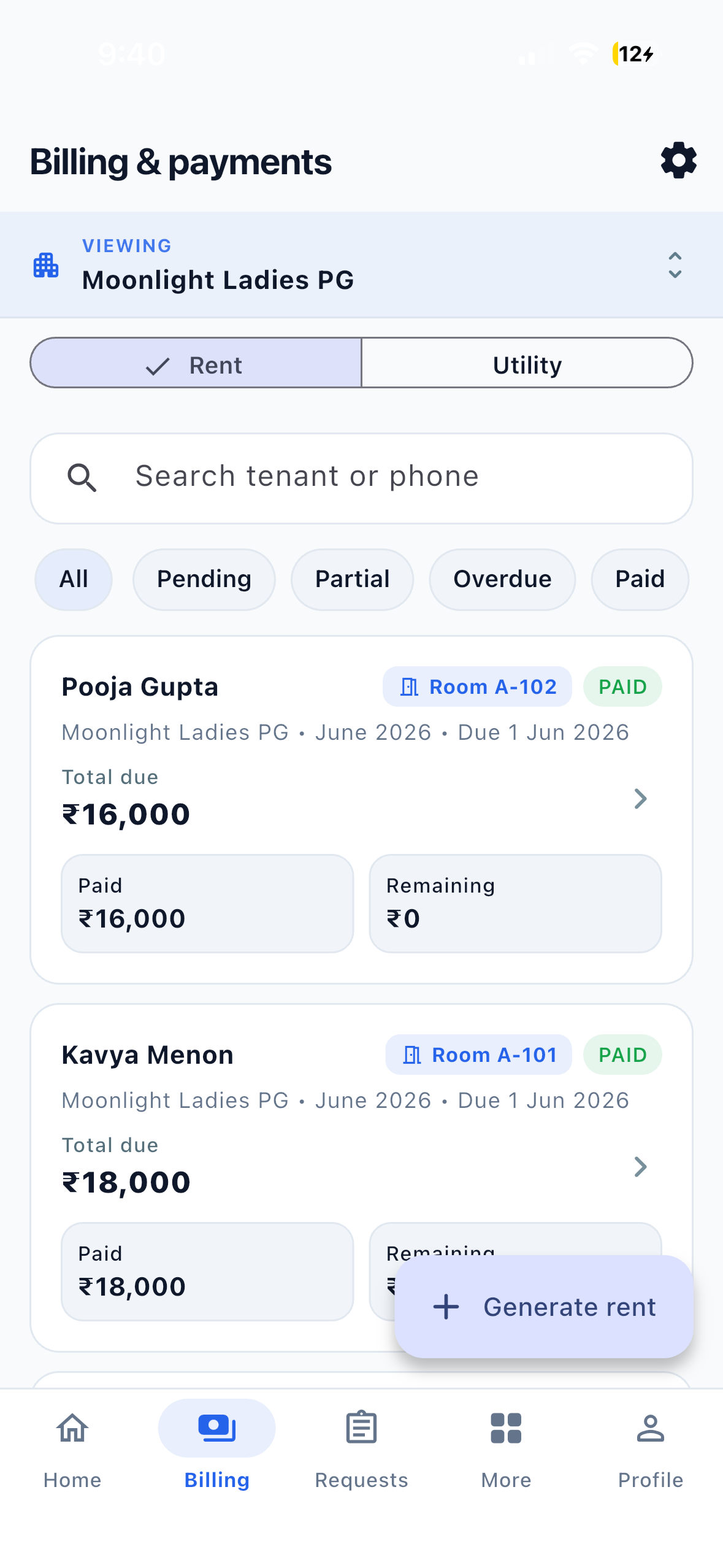
Tenants see what they owe and submit UPI proof once. Staff verify in a defined workflow. Owners see collected, pending, and overdue on a dashboard — not buried in message history.
Rent collection should not depend on memory
One of the biggest warning signs in a growing PG: critical payment information exists only in someone’s head.
If your manager leaves tomorrow, can someone else immediately see pending payments, verified payments, and outstanding dues across every tenant?
If not, the process is fragile. Businesses scale when systems hold information — not individuals.
Chasing rent vs managing rent
| Chasing rent (reactive) | Managing rent (structured) |
|---|---|
| Reminders sent manually every month | Rent auto-generated; tenants notified in-app |
| Proofs scattered across WhatsApp | Proof submitted once with UTR attached |
| Owner scrolls to verify | Staff verify in workflow; owner sees status |
| “Did I already pay?” disputes | Clear payment history per tenant |
| Month-end rebuild in Excel | Reports export in minutes |
| Depends on owner’s memory | Depends on the system |
The goal is not simply to collect money. It is to create a process where tenants know what is due, staff know what is pending, and owners know what has been verified — without endless follow-ups.
Pair this with how to track PG occupancy — rent only matters when beds are filled, but chasing rent on empty spreadsheets wastes time either way.
Final thoughts
Many PG owners believe rent collection is hard because tenants delay payments. Often, the bigger challenge is the system surrounding those payments.
When records are scattered across chats, spreadsheets, and notebooks, even on-time payments create extra work. The larger your PG becomes, the more expensive this inefficiency gets.
A structured rent process does not just improve collections. It gives owners something far more valuable: time. And for a growing PG business, time is often the most scarce asset of all.
EasyAavaas helps PG owners track dues, payment proofs, verification status, and rent records in one place — reducing endless follow-ups and manual tracking. Free for owners, managers, and tenants.
For the full operational playbook, see The complete guide to running a PG, hostel or co-living space in India.
Use a repeatable rent review
Start with the rent management guide. Confirm actual receipts, check outstanding balances, then adapt a polite rent reminder. Keep disputed or unverified records separate from confirmed paid rent.