

Police Verification for PG Tenants: Documents, Process and Records
What police or tenant verification means for a PG, the documents to collect, how online submission works in states that offer it, why rules differ by city, and how to keep ID copies out of WhatsApp chats.
Short answer
Police verification for PG tenants means telling the local police who is staying at your property, usually by submitting a tenant verification form with the tenant's ID, photograph, permanent address and contact details. Whether it is required, which form is used and whether you can submit online depends on your state and city: many state police forces offer online tenant verification through their citizen services portal, others take the form at the police station. Ask your local police station what applies. Collect the documents on joining day, keep copies in one secure place rather than in chats, and record when the form was submitted. EasyAavaas stores tenant documents in the tenant's profile; it does not do police verification.
Owners ask about tenant verification for two reasons: because the local police expect it, and because they want to know who is sleeping under their roof. Both are good reasons. This guide explains what verification usually involves, the documents to collect, how online submission generally works where it exists, and how to store copies responsibly. Requirements differ between states and cities and change over time, so treat this as a checklist of what to find out, not a statement of the law where you are.
Why tenant verification matters
- It may be expected locally. Many police jurisdictions in India ask owners to share details of tenants and paying guests. Where it applies, not doing it can create trouble for the owner, not the tenant.
- It protects other residents. A PG is a shared home. Knowing who each resident is, and having a permanent address and emergency contact, is basic care for everyone else in the building.
- It protects you in a dispute. When a tenant leaves with unpaid rent or an unreturned key, a verified permanent address and a named emergency contact are the only ways to follow up.
- It sets a tone. Tenants who are asked for proper documents on day one tend to treat the rules more seriously.
Documents usually asked for
The exact form differs by state, but tenant verification forms generally ask for the same core details. Collect these on joining day so you are never chasing a tenant for a photocopy later.
| Item | What to collect | Notes |
|---|---|---|
| Identity proof | A government-issued photo ID, as accepted by your local form | Check which IDs your police form accepts; some forms ask for a specific one |
| Photograph | A recent passport-size photo, or a clear selfie if the form allows | Many online portals accept an uploaded photo |
| Permanent address | The tenant's home address with a proof document | Needed for follow-up if the tenant leaves |
| Current workplace or college | Name and address of the employer or institution | Often asked for on the form; useful for you as well |
| Emergency contact | A parent or relative with phone number and relation | Some forms ask for it; collect it regardless |
| Previous address | Where the tenant stayed before | Asked for on some forms |
| Owner details | Your name, property address and contact | The form is about the property as well as the tenant |
Collect only what you need
Take the documents your form and your records genuinely require, and nothing more. The more copies you hold, the more you are responsible for.
How the process usually works
There are broadly two routes, and which one applies to you depends on where the property is.
- Online, through your state police citizen services portal. Many state police forces now offer tenant or paying-guest verification online. The owner creates an account, fills in the tenant's details, uploads the ID and photo and submits. Some portals give a reference number or acknowledgement to keep. The portal name and address differ by state, so search for your state police's official citizen services site rather than following a link from a forum.
- At the local police station. Where there is no online route, or where the station prefers paper, the owner fills a printed tenant verification form, attaches copies of the documents and submits it at the station with jurisdiction over the property. Ask for a stamped acknowledgement or note the date and the officer's name.
Some cities also ask owners to submit details within a set number of days of the tenant moving in, and some ask for an update when a tenant leaves. Whether either applies to you is a question for the local station.
Rules differ by state and city
There is no single national tenant verification process. Do not rely on a form or portal from another state, and be careful with unofficial websites that charge for "police verification". Confirm the official route with your local police station or your state police's official website. This guide is not legal advice.
How to keep ID copies safely
The most common way PG owners handle tenant IDs is the worst one: the tenant sends a photo of their ID on WhatsApp, it sits in the chat, gets forwarded to a warden, and nobody knows how many copies exist. Treat ID copies as something you are holding on trust.
- Keep all tenant documents in one place, whether that is a locked file or a single app, so you know where every copy is.
- Do not forward IDs in group chats or keep them in personal galleries.
- Give staff access only to the records they need. A cleaner does not need to see ID proofs.
- Record who reviewed the documents and when, so verification is not a guess later.
- When a tenant leaves, decide how long you keep the copies and remove them when they are no longer needed for your records or any local requirement.
Collecting tenant documents in EasyAavaas
EasyAavaas does not submit police verification or check documents against any government database. What it does is keep each tenant's documents in their profile, so the copies you collected for the verification form are in one place instead of in chats. The documents section has categories for ID proof, address proof, agreement and selfie. Tenants can upload from their own app, or owners and permitted staff can upload on the profile and send a reminder to the tenant to upload. The owner or permitted staff review the files and mark the profile verified; the app records who verified it and when, and clears the mark if a new document is uploaded later.
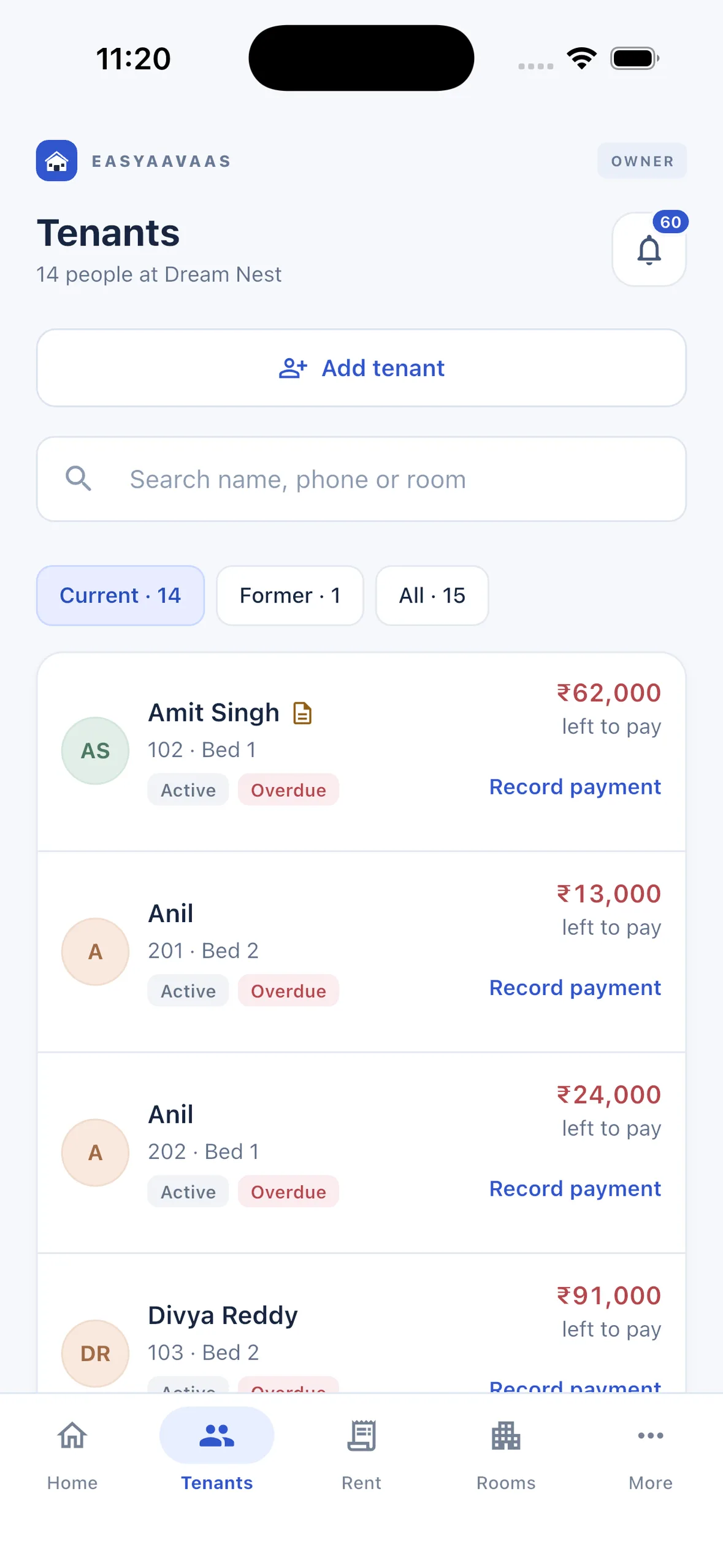
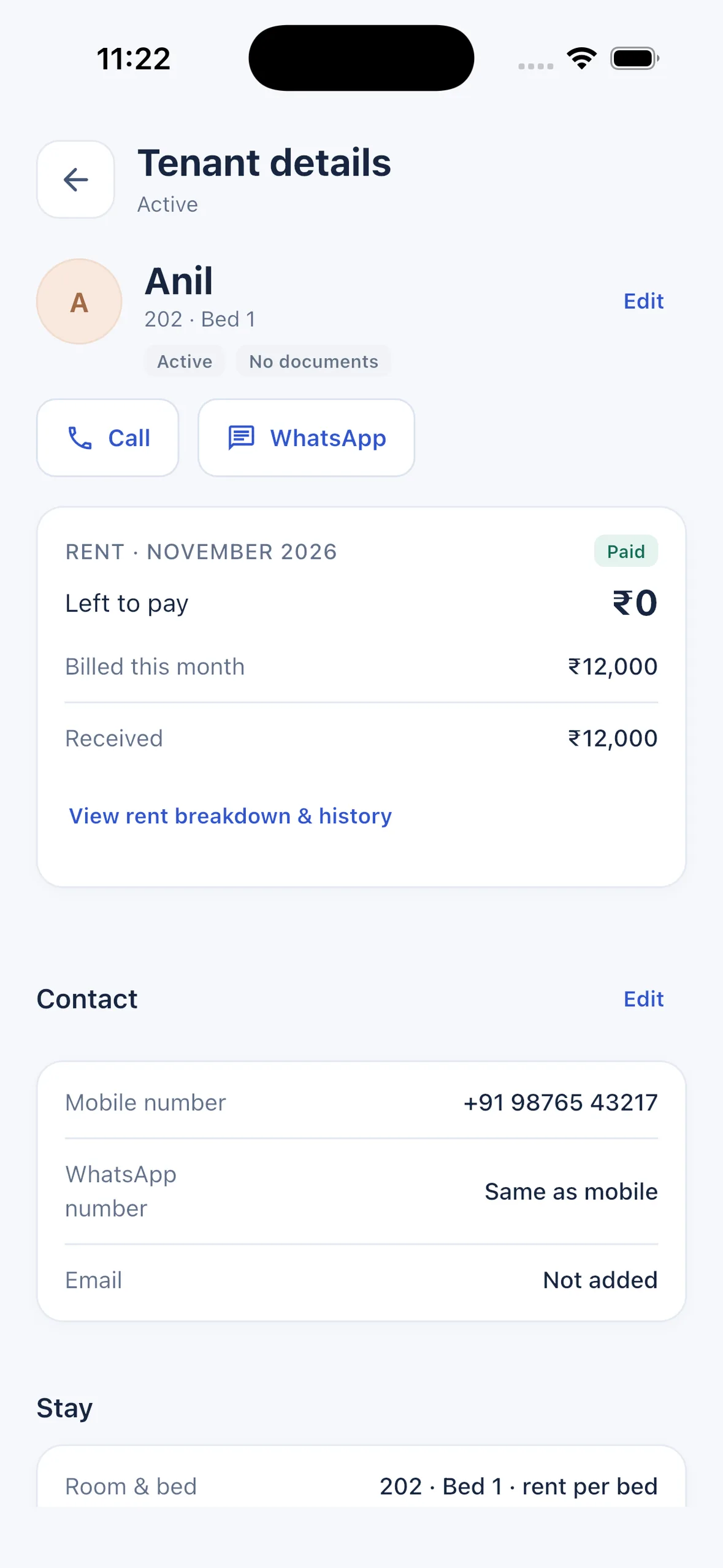
The same profile holds the permanent address, emergency contact and workplace details you collected for the form, with Call and WhatsApp buttons to reach the tenant. Documents are visible to people with access to that tenant's record in the app, so set staff access with care. The tenant management software page explains document review and role access, and the tenant onboarding checklist lists what else to record on joining day.
Tenant verification checklist
- Asked the local police station whether tenant or PG verification applies, and which route to use
- Found the official state police portal, if online submission is offered
- Collected ID proof, photo, permanent address proof, workplace or college and emergency contact on joining day
- Submitted the form and kept the acknowledgement or reference number
- Noted the submission date in the tenant's record
- Uploaded document copies to one place and removed them from chats
- Reviewed the documents and marked the record verified
- Checked whether a move-out update is expected locally
Questions about PG tenant verification
Is police verification mandatory for PG tenants?
It depends on where the property is. Many police jurisdictions ask owners to submit tenant or paying-guest details, some do not, and the process changes over time. Check with your local police station or your state police's official website. This guide is not legal advice.
Can I do tenant verification online?
In many states, yes. State police citizen services portals often include a tenant or paying-guest verification form where the owner enters the tenant's details and uploads documents. Use your state police's official site, not a third-party website that charges a fee, and keep the acknowledgement.
What documents do I need for a tenant verification form?
Typically a government photo ID, a recent photograph, the tenant's permanent address with proof, their workplace or college, an emergency contact and sometimes a previous address, plus your own details as owner. The exact list depends on your state's form.
Does EasyAavaas do police verification or check Aadhaar?
No. EasyAavaas stores tenant documents in the tenant's profile and lets the owner or permitted staff review them and mark the profile verified. It does not submit anything to the police and does not check documents against Aadhaar, DigiLocker or any government database.
Where should I keep copies of tenant IDs?
In one place with controlled access, not in WhatsApp chats or personal photo galleries. Record who reviewed each document and when, give staff access only where needed, and remove copies when you no longer need them for your records or any local requirement.