

How to Start a PG Business in India: Steps, Costs and Records
A step-by-step plan for opening a paying guest accommodation: location and demand, the property and permissions, how to estimate costs, registrations that vary by city, pricing, deposits, house rules, staff and the records to keep from the first tenant.
Short answer
To start a PG business in India, pick a location with steady demand from students or working people, secure a property you own or have written permission to sub-let as a PG, estimate your one-time and monthly cost heads before you commit, ask the local municipal body and police which licences and registrations apply in your city, decide per-bed or whole-room pricing with a clear deposit and notice policy, write house rules, and keep tenant, rent and deposit records from the first day. Licences, taxes and verification rules differ by state and city, so this guide tells you what to ask about, not what the law is where you are.
A PG, or paying guest accommodation, rents beds or rooms to people who need a place to stay near their college or office, usually with some services such as cleaning, Wi-Fi or meals. It is one of the most common small businesses in Indian cities because the demand is steady and the setup is simpler than a hotel. It is still a business with real costs, real rules and real records. This guide walks through the decisions in the order you will meet them. It is practical guidance from running PGs, not legal, tax or investment advice.
Step 1: Check location and demand before anything else
A PG fills because of what is nearby. Before you look at a property, answer three questions: who will stay here, how will they reach work or college, and what do they pay today?
- Who is the tenant? Students near a college or coaching centre, working people near an office cluster, hospital staff near a hospital, or a mix. Each group wants different things: students care about price and food, working people care about commute and quiet.
- How close is the demand? Walk the area. Note the colleges, offices, metro or bus stops and the distance from the property on foot. A 10-minute walk fills faster than a 25-minute one.
- What do nearby PGs charge? Visit three or four as a prospective tenant. Note their per-bed price, sharing type, what is included and whether they have vacant beds. Many vacant beds in the area is a warning sign.
- Is the demand seasonal? Student PGs empty during long breaks and fill at admission time. Working-tenant PGs are steadier. Plan your cash for the empty months.
Do not rely on market reports
City-level rent averages tell you little about one building on one street. Your own survey of the nearest PGs is the only demand data that matters for your pricing.
Step 2: The property and the owner's permission
Most new PG operators do not own the building. They lease a house or floor from an owner and run the PG inside it. If that is your plan, the lease must say clearly that you may run a paying guest accommodation and sub-let beds or rooms. A normal residential lease often does not allow this, and an owner who finds out later can end the arrangement.
- Get the PG use and sub-letting permission in writing, inside the lease itself.
- Agree who pays for fit-out (beds, cupboards, water heaters, wiring) and who owns it when the lease ends.
- Agree a lease term long enough to recover your fit-out cost. A one-year lease with a large fit-out spend is a common mistake.
- If the building is in a housing society or has a resident welfare association, ask whether running a PG needs their consent. Rules differ between societies and cities.
- Check the building for basics tenants notice first: water supply, power backup, mobile signal, ventilation and a safe stairway.
Step 3: Estimate your cost heads honestly
There is no single figure for how much a PG costs to start, because it depends on the city, the building size, whether you lease or own, and how much you furnish. What you can do is list every cost head and put your own local quotes against each one. Split them into one-time and monthly.
| Cost head | One-time or monthly | How to estimate it |
|---|---|---|
| Lease deposit to the building owner | One-time | Ask the owner; often several months of rent, varies by city |
| Building rent | Monthly | The lease figure, plus any yearly increase written in the lease |
| Beds, mattresses, cupboards, fans, lights | One-time | Count beds per room, get quotes from two local suppliers |
| Kitchen, water heaters, water purifier, washing machine | One-time | Decide what you will provide, then price it |
| Minor civil work and painting | One-time | Get a contractor estimate after a site visit |
| Electricity and water | Monthly | Ask the owner for past bills; add for ACs or heaters if you install them |
| Wi-Fi and cable | Monthly | Local provider quotes for the number of users |
| Cleaning and cook staff | Monthly | Local wage rates for the hours you need |
| Food, if you provide meals | Monthly | Cost per person per day times expected occupancy |
| Repairs and replacements | Monthly, as a reserve | Set aside a fixed amount each month; see the operating cost guide |
| Licences and registrations | One-time and renewals | Ask the local municipal office; fees differ by city |
Once the list is filled in, work out the minimum occupancy at which monthly income covers monthly costs. If that break-even needs almost every bed full, the plan is too tight. The PG operating expenses and cash planning guide goes deeper into monthly costs and the empty months.
Step 4: Registrations and licences to ask about
This is where most online guides go wrong. There is no single national PG licence. What applies to you depends on your state, your city, the size of the building and sometimes the number of beds. The list below is what owners commonly need to ask about. Confirm each one with the local municipal body, your state portal or a qualified professional before you open.
- Local trade or shop and establishment registration. Many municipalities treat a PG as a commercial activity and want it registered. Some cities have a specific PG registration; others use a general trade licence. Ask the municipal office directly.
- GST. GST registration depends on your turnover and the nature of the service, and the rules on accommodation services have changed over time. Ask a chartered accountant whether you need to register and what rate, if any, applies to your rent and meals.
- Fire safety. Larger buildings, taller buildings or buildings above a certain number of occupants may need a fire no-objection certificate from the local fire department. Smaller PGs may not, but basic fire safety (extinguishers, clear exits) is sensible everywhere.
- Society or RWA permission. If the property is in a housing society, the society's rules may require consent for commercial use. Get it in writing.
- Police intimation and tenant verification. Some police jurisdictions ask owners to submit tenant details. See the police verification guide for PG tenants.
- Food licence. If you serve meals, a food business registration or licence may apply. Check with the food safety authority in your state.
- Income tax. Rent income is taxable. Keep records and ask a professional how to file.
Rules change and differ by city
Do not rely on another owner's experience in a different city, or on a forum post from two years ago. Call or visit the local municipal office, and ask a chartered accountant about GST and income tax. This guide is not legal or tax advice.
Step 5: Decide pricing per bed or per room
PGs usually charge per bed in shared rooms, with single, double and triple sharing at different prices. Some rooms or whole floors may be let as a unit instead. Decide this room by room, because it changes how you count vacancies and how you bill.
| Model | How it works | When it suits |
|---|---|---|
| Per bed | Each bed has its own tenant, rent and due date | Shared rooms for students and working people; the normal PG model |
| Whole room | One tenant or one group rents the full room | Couples, families, small groups or premium single rooms |
| Mixed | Some rooms per bed, some whole room | Most real PGs; needs clear records of which is which |
- Set the price from your local survey, not from a wish. Start a little below the nearest comparable PG until you have reviews and referrals.
- Write down exactly what the rent includes: electricity, Wi-Fi, meals, cleaning. Surprises here cause more arguments than the rent amount.
- Decide the due date and any grace period, and tell every tenant the same thing.
- Decide how you will handle electricity for ACs or heaters: included, metered or a flat add-on. The electricity and extra charges guide covers common methods.
Step 6: Deposits, notice period and house rules
A security deposit protects you against unpaid rent and damage, and a notice period protects you against a bed emptying with no warning. Both only work when they are written down and the tenant has agreed to them before moving in.
- Deposit: decide the amount (often one or two months of rent, but set it by your local market), how it is paid and when it is refunded. Keep deposits separate from rent in your records. The deposit and checkout records guide explains why.
- Notice period: state it clearly, along with what happens if a tenant leaves early.
- House rules: entry timings if any, visitor policy, quiet hours, cooking, smoking and alcohol, guest stays, cleaning duties and what counts as damage.
- Written agreement: put the rent, deposit, notice period and rules in a signed document. The PG rent agreement format guide lists the clauses to include.
Step 7: Staff and who does what
A small PG of 10 to 30 beds can run with the owner and one cleaner. Beyond that, most owners add a warden or manager who lives on site or visits daily, a cook if meals are offered, and sometimes a security guard at night. Decide early who collects rent, who handles complaints and who can see tenant documents, and give each person only the access they need. The guide to managing a small PG alone covers a normal week for a solo owner.
Step 8: Keep records from the first tenant
The owners who struggle a year in are usually the ones who started with rent in a notebook and tenant details in WhatsApp chats. Records are easy to keep from day one and painful to rebuild later. At minimum, keep for each tenant: name and mobile number, emergency contact, joining date, room and bed, agreed rent and due date, deposit paid, documents collected and items handed over. Then keep a rent record for every month and every payment.
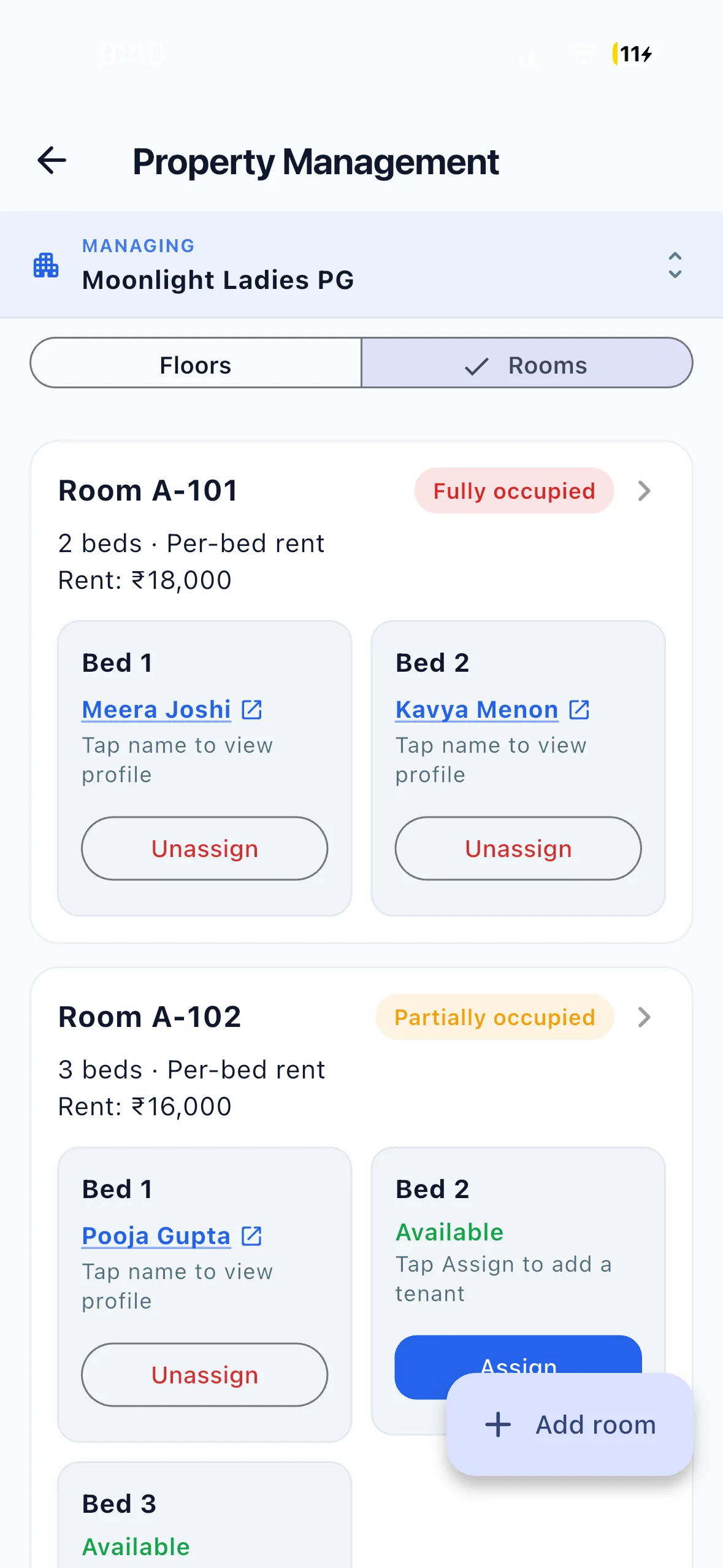
EasyAavaas is a free app built for exactly this. You set up the property with floors, rooms and beds, add tenants with their documents and deposit, and record each rent payment as it comes in by UPI, cash or bank transfer. Tenants get WhatsApp rent reminders, and the home screen shows rent collected this month, who still has dues and which beds are vacant. It is free forever with no limit on beds or properties, on Android and iOS, in English and Hindi.
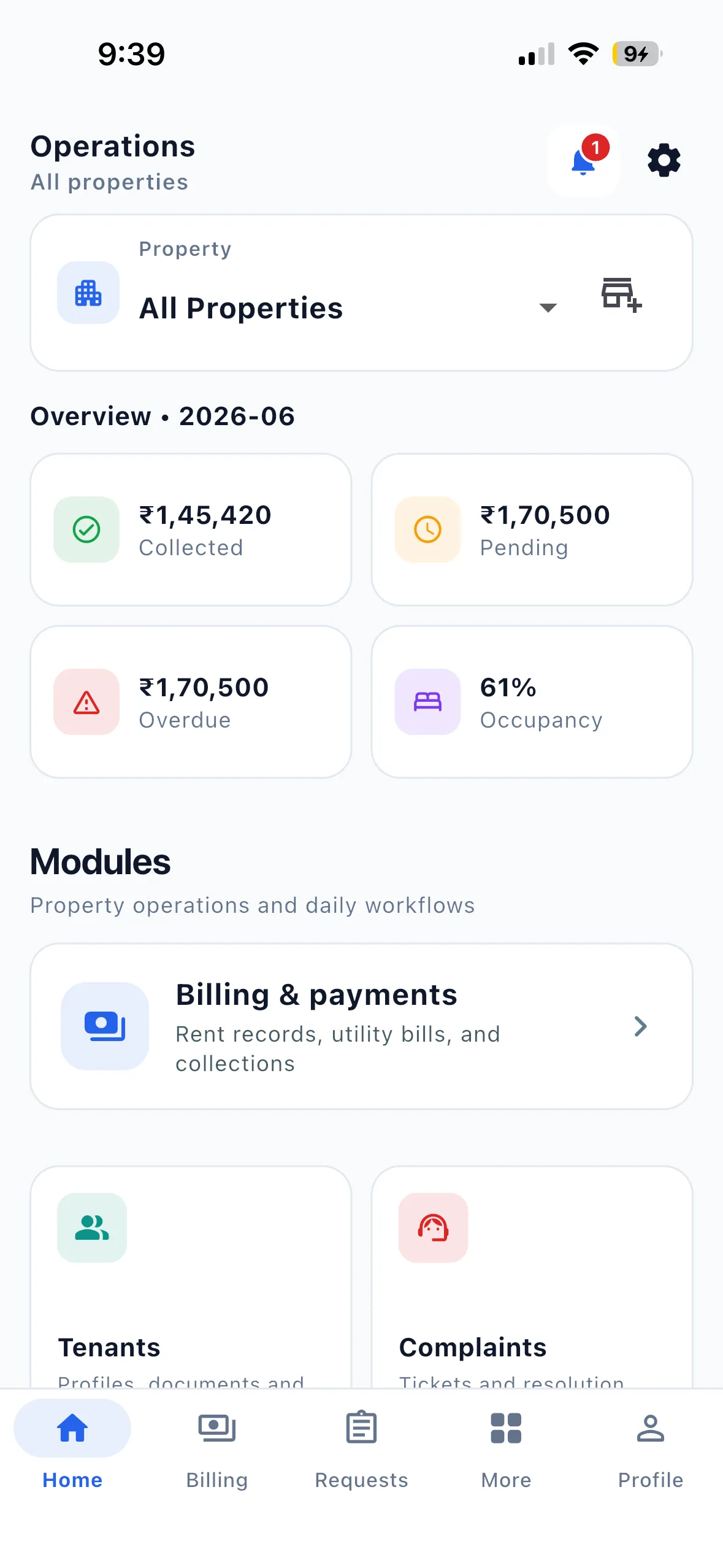
The PG tenant onboarding checklist lists what to record on joining day, and the rent management software page shows how rent records, reminders and payment proof work in the app.
PG launch checklist
- Local demand surveyed: nearby colleges, offices, transport and three or four competing PGs
- Lease signed with written permission for PG use and sub-letting
- Society or RWA consent, if the building needs it
- Cost sheet filled with local quotes; break-even occupancy worked out
- Municipal office asked which licence or registration applies; applied for
- Chartered accountant asked about GST and income tax
- Fire safety checked, and a fire NOC applied for if the building size needs it
- Per-bed and whole-room prices set, with inclusions written down
- Deposit amount, refund terms and notice period written
- House rules written and ready to share
- Rent agreement template ready
- Tenant verification process confirmed with the local police
- Staff roles and access decided
- Property, rooms and beds set up in your records or app before the first tenant
Questions about starting a PG
How much does it cost to start a PG in India?
It depends on your city, the building size, whether you lease or own, and how much you furnish. Instead of a single figure, list every cost head, such as lease deposit, rent, beds and furniture, appliances, civil work, licences and a repair reserve, and put local quotes against each. Then work out the occupancy at which monthly income covers monthly costs.
Is a PG business profitable?
It can be, when the location has steady demand, the building rent is reasonable against the number of beds, and occupancy stays high most of the year. Profit falls quickly when beds stay empty, rent goes uncollected or repairs are ignored. Good records and regular rent collection matter as much as the location.
Which licence is needed to run a PG?
There is no single national PG licence. Depending on your state and city you may need a municipal trade or PG registration, a shop and establishment registration, a fire NOC for larger buildings, a food licence if you serve meals and GST registration above a turnover threshold. Ask the local municipal office and a chartered accountant.
Can I run a PG in a rented house?
Only if the building owner agrees in writing, inside the lease, that you may run a paying guest accommodation and sub-let beds or rooms. A standard residential lease often does not allow this. If the house is in a society, check whether the society needs to consent as well.
Should I charge per bed or per room?
Most PGs charge per bed in shared rooms and may let a few rooms as a whole unit. Decide room by room, write down what the rent includes, and keep records of which model applies to each room so vacancy counts and billing stay correct.
Does EasyAavaas help with licences or registrations?
No. EasyAavaas keeps your property, tenant, rent and deposit records and sends WhatsApp rent reminders. Licences, GST, agreements and police verification are handled outside the app with the relevant authorities and professionals.