

PG Rent Agreement Format: Clauses Every Owner Should Include
The clauses a PG agreement needs, leave-and-licence versus rent agreement in simple words, why stamp duty and registration depend on your state, and a plain-text clause list you can adapt with a professional.
Short answer
A PG rent agreement should state the rent and what it includes, the due date and grace period, the deposit and how it is refunded, the notice period and any lock-in, house rules and the visitor policy, who pays for electricity and maintenance, how damages are handled, and the room or bed allotted. Most PG stays are set up as a leave-and-licence or paying-guest arrangement rather than a tenancy, and whether the document needs stamp duty or registration depends on your state and the stay length. Use the clause list below as a starting point and have a local professional check it. EasyAavaas does not generate agreements; it stores the signed copy in the tenant's profile.
Most PG disputes are about things that were never written down: whether the deposit covers the last month, how much notice was agreed, who pays for the broken geyser. A short, clear agreement that the tenant signs on joining day settles most of these before they start. This guide covers what to include, the difference between a rent agreement and a leave-and-licence, and a plain clause list you can adapt. It is operational guidance, not legal advice; agreement formats and registration rules differ by state.
Why a written agreement matters even for a single bed
Owners sometimes skip the paperwork for short stays or shared rooms because the amounts feel small. The cost of a dispute is the same whether the bed is ₹6,000 or ₹16,000 a month: a tenant who leaves without notice, a deposit argument at checkout, a parent who calls insisting the rent included meals. One page that both sides signed answers all three.
Clauses to include in a PG agreement
| Clause | What to state | Why it matters |
|---|---|---|
| Parties and property | Owner or operator name, tenant name, mobile number, permanent address, property address | Identifies who agreed to what, and where |
| Room and bed | The room number and bed, and the sharing type (single, double, triple) | Stops arguments when a tenant is moved or a room changes |
| Stay period | Start date, and end date or month-to-month | Sets when notice and renewal apply |
| Rent and inclusions | Monthly amount and exactly what it includes: electricity, Wi-Fi, meals, cleaning, water | The most common dispute is about inclusions, not the amount |
| Due date and grace | Date rent is due each month, any grace period and what happens after it | Makes reminders and late follow-up fair and predictable |
| Payment method | UPI, bank transfer or cash, and that the tenant should keep proof | Both sides have a record of each payment |
| Security deposit | Amount, when it is paid, that it is refundable, and when and how it is returned | Deposit refunds are the biggest checkout flashpoint |
| Deductions from deposit | What can be deducted: unpaid rent, unpaid charges, damage beyond normal wear, unreturned items | Sets expectations before anything goes wrong |
| Notice period | How much notice each side gives, and in what form (written message is fine) | Protects against a bed emptying overnight |
| Lock-in, if any | A minimum stay and what happens if the tenant leaves earlier | Common for student PGs; keep it reasonable and clear |
| House rules | Entry timings if any, quiet hours, cooking, smoking, alcohol, cleanliness | Rules you did not write down are hard to enforce |
| Visitors and guests | Who may visit, when, and whether overnight guests are allowed | Avoids friction with other tenants and the building |
| Electricity and maintenance | Whether electricity is included, metered or a flat charge; who pays for repairs | See the electricity and extra charges guide |
| Damages | Tenant is responsible for damage caused by them or their guests; how it is assessed | Links to the checkout inspection |
| Items issued | Keys, mattress, cupboard or other items handed over, and that they must be returned | Checked again at move-out |
| Termination for breach | What behaviour lets the owner end the stay, with notice | Needed for serious rule breaches |
| Signatures and date | Both parties sign and date; attach ID copies if your process collects them | The document is only useful if signed |
Keep it short
A two-page agreement the tenant actually reads is worth more than a ten-page one copied from the internet. Plain sentences, one idea per clause, numbers written out in figures.
Leave-and-licence vs rent agreement, in simple words
The two terms come up constantly and confuse new owners. In plain language: a rent or lease agreement gives the tenant a right to occupy the premises for the period, with protections that tenancy laws in some states attach to it. A leave-and-licence (or paying-guest) agreement gives the person permission to use the space on your terms while the owner keeps possession and control. PG stays, where the owner controls the building, sets house rules and provides services, are usually set up as leave-and-licence or paying-guest arrangements.
| Point | Rent or lease agreement | Leave-and-licence or PG agreement |
|---|---|---|
| What the tenant gets | A right to occupy for the term | Permission to use the space on the owner's terms |
| Who controls the premises | Largely the tenant during the term | The owner keeps possession and control |
| Typical use | Whole house or flat let to a family | Beds or rooms in a PG, hostel or co-living building with services |
| Registration and stamp duty | Depends on state and term | Depends on state and term; some states require registration for licences above a certain length |
The label on the document matters less than what it actually says, and courts look at the substance. If you are unsure which form suits your property, ask a local advocate or notary who handles rental paperwork in your city. This guide does not tell you which is legally right for you.
Stamp duty, notarisation and registration depend on your state
Whether a PG agreement needs stamp paper, notarisation or registration with the sub-registrar depends on the state the property is in, the length of the stay and sometimes the rent amount. Some states have an online rent-agreement registration system; others rely on stamp paper and a notary; many owners use a simple signed agreement for short stays. Stamp duty rates and thresholds change, so do not copy a figure from a forum post.
- Ask a local notary, advocate or the state registration department which format and stamp value applies for a PG stay of your typical length.
- If your state offers online registration of rent or licence agreements, check whether it covers paying-guest arrangements.
- Whatever the format, keep one signed copy for yourself and give one to the tenant.
- Review the format once a year, or when you change rent, deposit or rules.
Sample PG agreement clause list (adapt with a professional)
Below is a plain-text clause list you can adapt. Replace the bracketed items with your details. It is an outline, not a legal template, and should be reviewed by someone qualified in your state before you use it.
- Parties. This agreement is between [Owner or operator name], of [property address] (the Owner), and [Tenant name], mobile [number], permanent address [address] (the Resident).
- Accommodation. The Owner allows the Resident to use Bed [number] in Room [number] ([sharing type]) at [property address] as a paying guest, together with shared facilities listed in the house rules.
- Period. The stay begins on [date] and continues month to month until ended by notice under clause 8. [Optional: minimum stay of [number] months.]
- Rent. The Resident pays ₹[amount] per month. Rent includes [list: electricity up to a fair-use limit, Wi-Fi, cleaning, water, meals as described]. It does not include [list].
- Due date. Rent is due on or before the [date] of each month. A grace period of [number] days applies. Rent is paid by UPI, bank transfer or cash, and the Resident keeps proof of each payment.
- Security deposit. The Resident pays a refundable deposit of ₹[amount] on or before [date]. The deposit is not rent and cannot be adjusted against the last month's rent unless the Owner agrees in writing.
- Deposit refund. Within [number] days of move-out, the Owner returns the deposit after deducting unpaid rent or charges, the cost of damage beyond normal wear, and the cost of unreturned items. Any deduction is listed in writing with a reason.
- Notice. Either side may end the stay by giving [number] days written notice, including by message. [Optional: if the Resident leaves before the minimum stay, [state consequence].]
- House rules. The Resident agrees to the house rules attached to this agreement, including [entry timings if any], quiet hours, no smoking or alcohol in [areas], and cleanliness of shared areas.
- Visitors. Visitors are allowed [timings and areas]. Overnight guests are [not allowed / allowed only with the Owner's prior permission].
- Electricity and maintenance. [Electricity is included up to a fair-use limit / is charged by meter / is a flat ₹[amount] per month for rooms with AC.] Routine maintenance is the Owner's responsibility; the Resident reports faults promptly.
- Damages. The Resident is responsible for damage caused by the Resident or their guests. Damage is assessed at a joint inspection at move-out, with photographs.
- Items issued. The Resident has received [list: room key, cupboard key, mattress] and must return them in good condition at move-out.
- Documents. The Resident has provided copies of [ID proof, address proof, photograph] for the Owner's records.
- Termination for breach. The Owner may end the stay with [number] days notice for serious or repeated breach of the house rules, non-payment of rent beyond the grace period, or behaviour that disturbs other residents.
- Nature of the arrangement. This is a paying-guest or licence arrangement. The Owner keeps possession and control of the premises. No tenancy is created.
- Signatures. Signed by the Owner and the Resident on [date] at [place], each keeping one copy.
Not legal advice
Clause wording, stamp duty, registration and what you may deduct from a deposit depend on your state and on the facts. Have a local advocate or notary review your agreement before you use it, and update it when rules change.
Where the signed agreement lives in EasyAavaas
EasyAavaas does not generate or e-sign agreements. What it does is keep the signed copy with the tenant's other records so you are not searching a WhatsApp chat a year later. Each tenant profile has a documents section with categories for ID proof, address proof, agreement and selfie. You or your staff can upload the signed agreement from the owner app, or the tenant can upload it from their own app, and the owner or permitted staff review the files and mark the profile verified. The same profile holds the agreed rent, deposit record, items issued and emergency contact, so the agreement and the live records sit together.
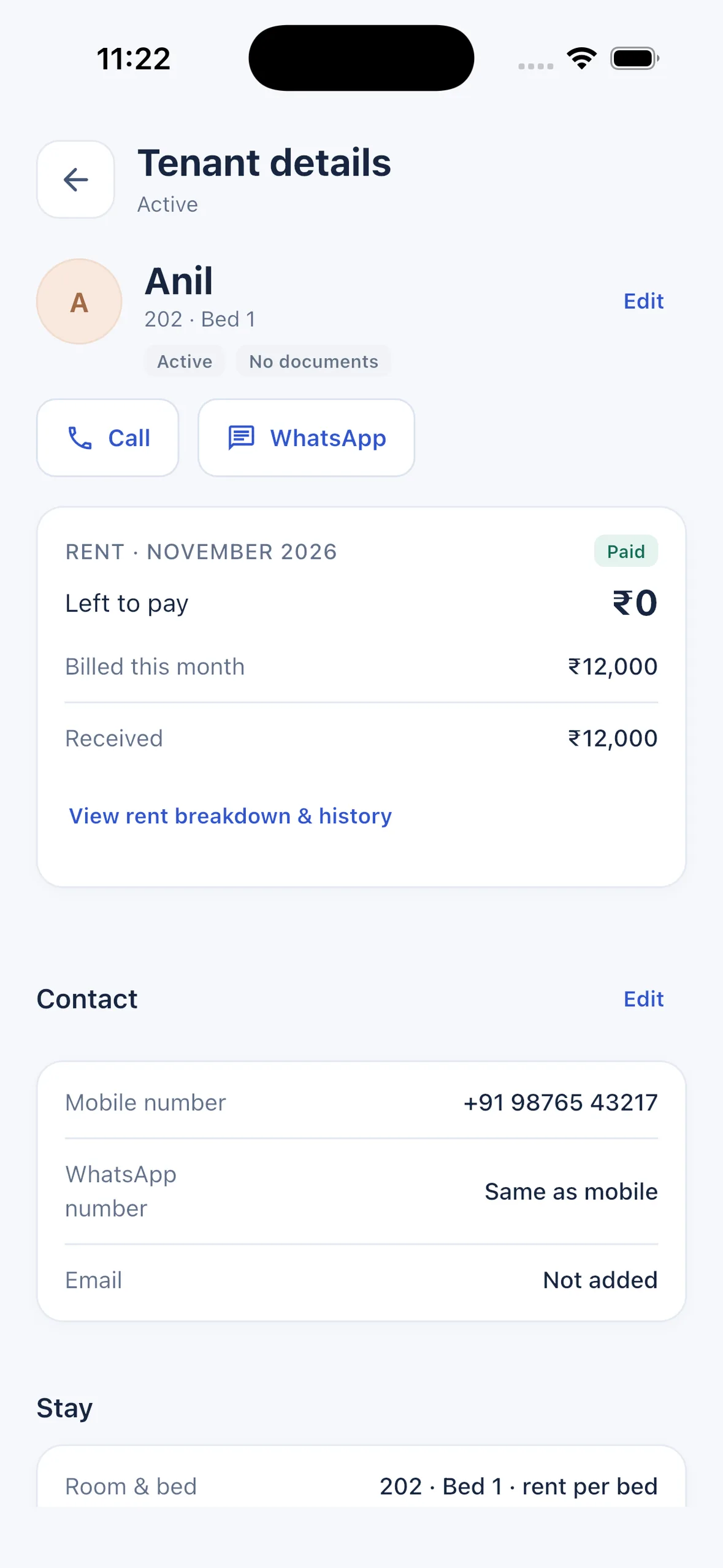
Documents in the app are visible to people who have access to that tenant's record, so give staff only the access they need. The tenant management software page describes document review and roles in detail, and the tenant onboarding checklist lists what else to record on joining day.
Common PG agreement mistakes
- Copying a residential lease template that gives the tenant rights you did not intend for a shared room.
- Leaving inclusions vague ("all facilities included") and arguing about AC bills later.
- No notice period, so a bed empties with a message the night before.
- Deposit terms that silently let the tenant adjust it against the last month's rent.
- A lock-in with no stated consequence, which nobody can enforce.
- Signing the agreement but never filing it, so neither side can find it at checkout.
Questions about PG rent agreements
Is a rent agreement necessary for a PG?
No law forces a particular format on every PG, and the rules differ by state. Practically, a short signed agreement covering rent, inclusions, deposit, notice and house rules prevents most disputes and is worth doing for every tenant, even for a single bed in a shared room.
What is the difference between a PG agreement and a leave-and-licence?
A PG or paying-guest agreement is usually a form of leave-and-licence: the owner keeps control of the premises and allows the resident to use a bed or room with services on agreed terms. A rent or lease agreement gives the occupant a right to the premises for the term and can bring tenancy protections in some states. Ask a local professional which suits your property.
Does a PG agreement need to be registered or on stamp paper?
It depends on the state the property is in, the length of the stay and sometimes the rent amount. Some states require registration above a certain term, some use stamp paper and a notary, and many short PG stays use a simple signed agreement. Check with a local notary, advocate or the state registration department.
Should the agreement be per bed or per room?
Write it the way you bill. For a shared room, name the bed and the sharing type so it is clear what the resident is paying for. For a whole room let to one person or a group, name the room and who is responsible for the rent.
Does EasyAavaas create or sign PG agreements?
No. EasyAavaas does not generate, fill or e-sign agreements. Owners and staff can upload the signed copy to the tenant's profile under the agreement category, alongside ID and address documents, and review it there.
What should the deposit clause say?
The amount, when it is paid, that it is refundable, how soon after move-out it is returned and what may be deducted: unpaid rent or charges, damage beyond normal wear and unreturned items. State that any deduction is listed in writing with a reason. What you may lawfully deduct depends on local rules.