

PG Operating Expenses and Monthly Cash Planning: A Worked Example
Separate recurring from irregular PG costs, set aside money for repairs, keep deposits apart and size a cash buffer, using a clearly labelled 50-bed example and a browser-only calculator.
Updated
Quick answer
Plan PG operating expenses in three layers: recurring monthly costs (building rent, salaries, internet, food), irregular costs averaged into a monthly set-aside (painting, appliance repairs, furniture), and a cash buffer that covers fixed costs for a chosen number of months. Plan with rent you actually expect to receive, not rent billed, and keep refundable deposits out of operating cash. EasyAavaas, the free PG management app, reports rent billed, collected, pending and overdue plus occupancy; your expenses and the plan itself stay in your own sheet or the PG cash planning calculator.
This guide is for a PG, hostel or co-living owner who wants to know whether next month's receipts will cover next month's costs, and how much to keep aside for the months that do not. It is an operating cash estimate, not accounting profit, a tax calculation or investment advice.
Recurring versus irregular PG costs
Most cash surprises come from mixing the two. Recurring costs arrive every month and are easy to see. Irregular costs arrive a few times a year and look like bad luck when they land, even though you knew a geyser or mattress would need replacing eventually.
| Cost type | Typical examples | How to plan it |
|---|---|---|
| Fixed recurring | Building rent or loan instalment, staff salaries, internet, common-area electricity and water | Same amount every month, whatever the occupancy |
| Per occupied bed | Food and groceries if meals are included, cleaning supplies, toiletries, laundry | Cost per occupied bed × occupied beds |
| Irregular | Painting, appliance repair or replacement, mattresses and furniture, plumbing and electrical work, pest control | Estimate a yearly total and set aside one-twelfth each month |
| Pass-through charges | Room electricity billed to tenants by meter or as a share | Plan the bill and the recovery together; a gap is a cost |
| Not operating cash | Refundable security deposits | Hold separately; they may have to be paid back at checkout |
Worked example: a 50-bed PG
Illustrative figures
Every number below is a made-up demonstration assumption, not a market average, a benchmark or a result from any real property. Replace each one with your own before relying on the answer.
Step 1: expected receipts. 50 beds available, 40 occupied, average rent ₹7,000 per occupied bed. Rent billed is 40 × ₹7,000 = ₹2,80,000. Assuming 95% is received within the month, expected receipts are ₹2,66,000. No other operating receipts are included.
Step 2: recurring costs. Fixed costs of ₹1,00,000 a month, plus ₹2,000 per occupied bed for food and consumables.
| Recurring cost (example) | Monthly amount |
|---|---|
| Building rent | ₹60,000 |
| Staff salaries (cook and cleaner) | ₹28,000 |
| Common-area electricity and water | ₹8,000 |
| Internet | ₹4,000 |
| Fixed costs subtotal | ₹1,00,000 |
| Food and groceries per occupied bed | ₹1,400 × 40 = ₹56,000 |
| Cleaning supplies and toiletries per occupied bed | ₹350 × 40 = ₹14,000 |
| Laundry per occupied bed | ₹250 × 40 = ₹10,000 |
| Per-bed costs subtotal | ₹2,000 × 40 = ₹80,000 |
| Total recurring costs | ₹1,80,000 |
Step 3: irregular costs as a monthly set-aside. Estimate what the year will need and divide by twelve.
| Irregular cost (example) | Yearly estimate |
|---|---|
| Painting and touch-ups | ₹60,000 |
| Appliance repair and replacement | ₹48,000 |
| Mattresses and furniture | ₹36,000 |
| Plumbing and electrical repairs | ₹24,000 |
| Pest control | ₹12,000 |
| Yearly total | ₹1,80,000 |
| Monthly set-aside (÷ 12) | ₹15,000 |
Step 4: the monthly picture. Expected receipts ₹2,66,000 minus recurring costs ₹1,80,000 leaves ₹86,000. After the ₹15,000 repair set-aside, ₹71,000 remains before loan principal, capital spending and tax, which this example excludes.
Run a downside month before it happens
A plan that only works in a good month is not a plan. Change one or two inputs at a time and record why.
| Scenario (example) | Receipts | Recurring costs | After ₹15,000 set-aside |
|---|---|---|---|
| Base: 40 beds, 95% received | ₹2,66,000 | ₹1,80,000 | ₹71,000 |
| Slow month: 34 beds, 90% received | ₹2,14,200 | ₹1,68,000 | ₹31,200 |
| Covers recurring costs only: 22 beds, 95% received | ₹1,46,300 | ₹1,44,000 | −₹12,700 |
| Also covers set-aside: 25 beds, 95% received | ₹1,66,250 | ₹1,50,000 | ₹1,250 |
In this example, about 22 occupied beds cover the recurring costs, and about 25 are needed to fund the repair set-aside as well. Each occupied bed adds ₹7,000 × 95% − ₹2,000 = ₹4,650 to the monthly result. Your break-even will be different; the point is to know yours before a slow month arrives.
How to size a cash buffer
A cash buffer pays the fixed costs when receipts fall short, for example while several beds refill after an exam season or a company relocation. One practical way to size it is to cover fixed costs for a chosen number of months. In the example, two months of fixed costs would be ₹2,00,000. Choose the number of months after looking at how long your beds usually take to refill and how many tenants tend to leave in the same month.
- Keep three pots apart: operating cash for this month, the repair set-aside, and the buffer.
- Keep deposits out of all three. A refundable deposit is money you may have to return at checkout. In the example, 40 deposits of ₹7,000 would be ₹2,80,000 held for tenants, not money available for the month.
- Refill the buffer first after a month in which you used it, before spending on upgrades.
- Write down large irregular costs when they happen so next year's set-aside estimate is based on your own history.
A simple PG business expense sheet
EasyAavaas does not record expenses, so keep a separate sheet. One row per payment is enough:
| Column | What to write |
|---|---|
| Date | The day you paid |
| Cost type | Fixed, per-bed, irregular or pass-through |
| Item | For example, salary for October or geyser repair, Room 4 |
| Amount | In rupees, as paid |
| Paid by | UPI, cash, bank transfer or card |
| Bill kept? | Yes or no, and where it is filed |
| Note | Anything you will need to remember at year-end |
What the app reports and what stays in your plan
Planning uses assumptions about the future. An app records what has already happened. Keep the two separate so an estimate is never mistaken for a record.
| Figure | Where it comes from |
|---|---|
| Rent billed for the month | EasyAavaas dashboard and the Property Summary report |
| Rent collected, pending and overdue | EasyAavaas dashboard; the Rent Ledger report lists each payment |
| Occupied and vacant beds, occupancy % | EasyAavaas dashboard and the Property Summary report |
| Deposits: amount, paid, remaining, refunds due | EasyAavaas deposit records (there is no separate deposit report) |
| Electricity and other charges billed to tenants | EasyAavaas utility bills, added to each tenant's rent record |
| Operating expenses | EasyAavaas expense records, with your accountant’s books used for formal accounts and tax |
| Repair set-aside, cash buffer and scenarios | Your plan or the cash planning calculator |
| Profit and loss, tax, loan schedules | Your accountant; EasyAavaas does not produce a P&L |
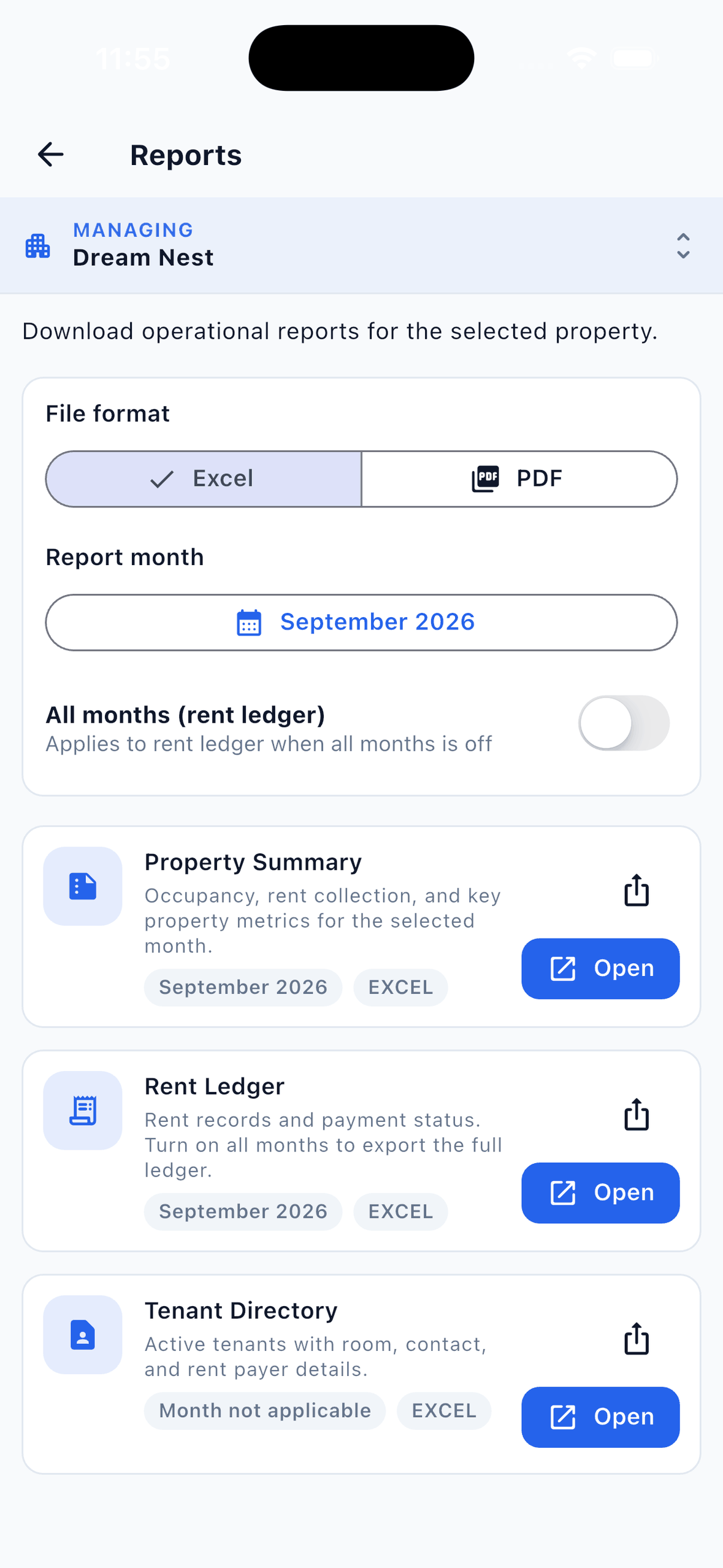
Reports are per property. The analytics dashboard overview explains each figure. Use the collected amount from the dashboard or the Rent Ledger as the actual receipts line in your plan, and use the PG cash planning calculator for the forward-looking scenarios. The calculator runs in your browser and does not upload your figures.
Monthly cash planning checklist
- Take last month's rent actually collected from the dashboard or Rent Ledger, not the billed figure.
- Total last month's expenses from your sheet, split into fixed, per-bed and irregular.
- Compare irregular spending with the set-aside and adjust the yearly estimate if it keeps running over.
- Check the deposit balance held for tenants and keep it out of operating cash.
- Update the calculator with current occupied beds and a collection percentage you have actually seen.
- Run one downside scenario: fewer beds, slower collection, or both.
- Write down one decision, such as refilling the buffer or delaying a purchase.
If receipts keep falling short of billed rent, the cause is often a record problem rather than a cost problem. Seven record mistakes that cost PG owners money covers missed payments, unbilled charges and vacant beds nobody can see. For the full operating cycle, see how to manage a PG in India.
Frequently asked questions
What are the main operating expenses of a PG?
Recurring costs usually include building rent or a loan instalment, staff salaries, internet, common-area electricity and water, and food and consumables if meals are included. Irregular costs include painting, appliance repairs, furniture and pest control. Your list depends on what the rent includes.
How much cash buffer should a PG owner keep?
There is no single right figure. One practical approach is to hold enough to pay fixed costs for a chosen number of months, plus a separate set-aside for irregular repairs, and to keep refundable deposits apart from both. Base the number of months on how long your beds usually take to refill.
Should security deposits count as income in cash planning?
Not for operating cash planning. A refundable deposit may have to be paid back at checkout, so keep it separate from rent and operating cash. Ask your accountant how to treat deposits in your accounts and tax.
Does EasyAavaas track PG expenses or profit?
No. EasyAavaas records rent billed, payments received, pending and overdue rent, deposits, utility charges and occupancy, and exports per-property reports in Excel or PDF. It does not record expenses or produce a profit and loss statement.
Is the PG cash planning calculator private?
Yes. Calculations run in your browser and your inputs are not uploaded. It uses one average rent and one collection percentage, and it excludes deposits, loan payments, capital spending and tax.